

This factsheet offers insights into Karnataka’s diverse economy, from its agricultural roots to its status as India’s leading tech hub. With a strong female workforce, the state’s Work Participation Rate (WPR) for women is 31.5%, according to the 2021-22 PLFS. Women are primarily engaged in agriculture in rural areas and manufacturing and services in urban regions. Explore Karnataka’s socio-economic landscape and workforce trends.
Women's Economic
Empowerment
IWWAGE’s work on women’s economic empowerment focuses on understanding and addressing the structural barriers that shape women’s participation in India’s labour market. At the centre of this agenda is the persistently low Female Labour Force Participation Rate (FLFPR), which reflects deep-rooted challenges related to access to decent work, social norms, and labour market institutions.
IWWAGE’s work in this area focuses on:
Evidence generation for policy action
Analysing national and state-level data to understand women’s employment patterns, sectoral and occupational distribution, and barriers to labour market entry and continuity.
Improving measurement and visibility of women’s work
Improved definitions and measurement of work, with a strong emphasis on recognising unpaid, home-based, and care work that remains undercounted in conventional labour statistics.
Shaping the future of women’s work
Examining women’s participation in a rapidly digitising economy, including platform and hybrid work models, to assess emerging opportunities, risks, and forms of precarity.
Strengthening agency and protection
Exploring women’s access to digital skills, agency, bargaining power, and social protection within evolving labour market arrangements.
Together, this body of work highlights that meaningful women’s economic empowerment requires better data, recognition of all forms of work, and the proactive shaping of labour market institutions so that women’s work is visible, valued, and protected.
Factsheet
Women’s Workforce Participation in India: Statewise Trends
- January , 2023
- Suchika Gupta, Sona Mitra
This factsheet highlights Kerala’s strong socio-economic indicators, including high literacy rates and a favorable sex ratio. Despite these achievements, the state’s Female Labour Force Participation Rate (FLFPR) remains low, with 29.5% in rural areas and 25.2% in urban areas. Explore key data on Kerala’s economy, gender wage gap, and human development in this comprehensive overview.
This factsheet highlights Kerala’s strong socio-economic indicators, including high literacy rates and a favorable sex ratio. Despite these achievements, the state’s Female Labour Force Participation Rate (FLFPR) remains low, with 29.5% in rural areas and 25.2% in urban areas. Explore key data on Kerala’s economy, gender wage gap, and human development in this comprehensive overview.
Factsheet
Women’s Workforce Participation in India: Statewise Trends
- January , 2023
- Trisha Chandra, Sona Mitra
Factsheet
Women’s Workforce Participation in India: Statewise Trends
- January , 2023
- Nidhi Gyan Pandey
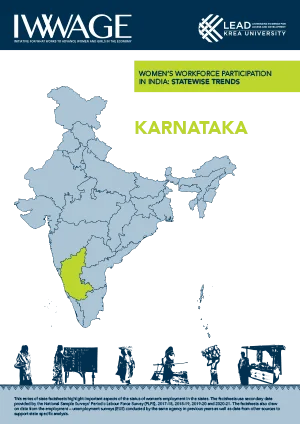
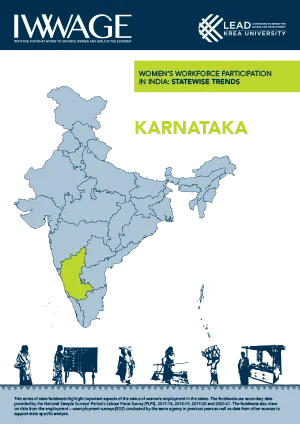
This factsheet offers insights into Karnataka’s diverse economy, from its agricultural roots to its status as India’s leading tech hub. With a strong female workforce, the state’s Work Participation Rate (WPR) for women is 31.5%, according to the 2021-22 PLFS. Women are primarily engaged in agriculture in rural areas and manufacturing and services in urban regions. Explore Karnataka’s socio-economic landscape and workforce trends.
This factsheet offers insights into Karnataka’s diverse economy, from its agricultural roots to its status as India’s leading tech hub. With a strong female workforce, the state’s Work Participation Rate (WPR) for women is 31.5%, according to the 2021-22 PLFS. Women are primarily engaged in agriculture in rural areas and manufacturing and services in urban regions. Explore Karnataka’s socio-economic landscape and workforce trends.
Learning note
Women’s Workforce Participation in India: Statewise Trends
- January , 2023
- Prakriti Sharma , Sona Mitra , Bidisha Mondal
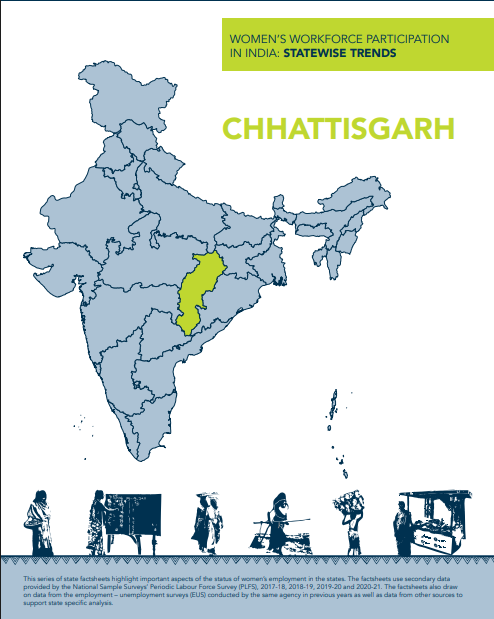
Chhattisgarh, located in east-central India, is the ninth largest state, with about 75% of its population residing in rural areas. Known as the ‘rice bowl of India,’ 70% of the state’s workforce depends on agriculture. Chhattisgarh has made significant strides in reducing multi-dimensional poverty, and its Female Work Participation Rate (FWPR) consistently surpasses the national average. In 2020-21, the state’s FWPR was 17 percentage points higher than the national figure. This factsheet explores Chhattisgarh’s socio-economic trends, focusing on women’s employment and the agricultural sector.
Chhattisgarh, located in east-central India, is the ninth largest state, with about 75% of its population residing in rural areas. Known as the ‘rice bowl of India,’ 70% of the state’s workforce depends on agriculture. Chhattisgarh has made significant strides in reducing multi-dimensional poverty, and its Female Work Participation Rate (FWPR) consistently surpasses the national average. In 2020-21, the state’s FWPR was 17 percentage points higher than the national figure. This factsheet explores Chhattisgarh’s socio-economic trends, focusing on women’s employment and the agricultural sector.
Learning note
Women’s Workforce Participation in India: Statewise Trends
- January , 2023
- Suchika Gupta , Sona Mitra , Bidisha Mondal
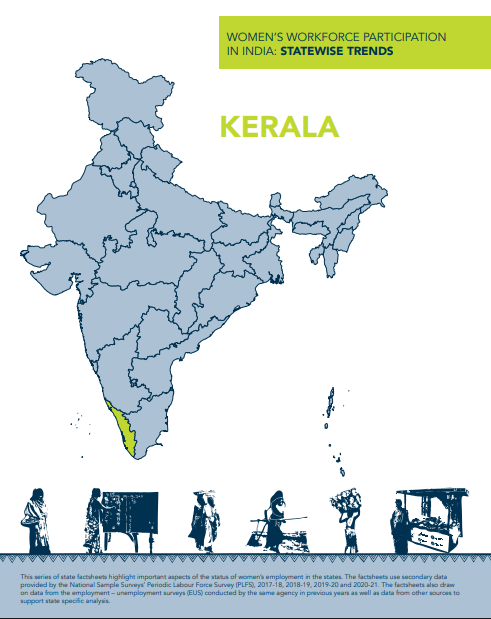
Kerala, a high-income Indian state with a per capita GSDP of INR 1,46,910, boasts impressive socio-economic indicators. It has one of the highest literacy rates in India, with minimal gender disparity-96% for men and 92% for women-and an outstanding sex ratio of 1,084. Despite these achievements, Kerala’s Female Labour Force Participation Rate (FLFPR) remains low, at 29.5% in rural areas and 25.2% in urban areas. This factsheet explores key aspects of Kerala’s economy, gender wage gap, and human development, offering insights into the state’s progress and ongoing challenges.
Kerala, a high-income Indian state with a per capita GSDP of INR 1,46,910, boasts impressive socio-economic indicators. It has one of the highest literacy rates in India, with minimal gender disparity-96% for men and 92% for women-and an outstanding sex ratio of 1,084. Despite these achievements, Kerala’s Female Labour Force Participation Rate (FLFPR) remains low, at 29.5% in rural areas and 25.2% in urban areas. This factsheet explores key aspects of Kerala’s economy, gender wage gap, and human development, offering insights into the state’s progress and ongoing challenges.
Learning note
Women’s Workforce Participation in India: Statewise Trends
- January , 2023
- Suchika Gupta , Sona Mitra , Bidisha Mondal
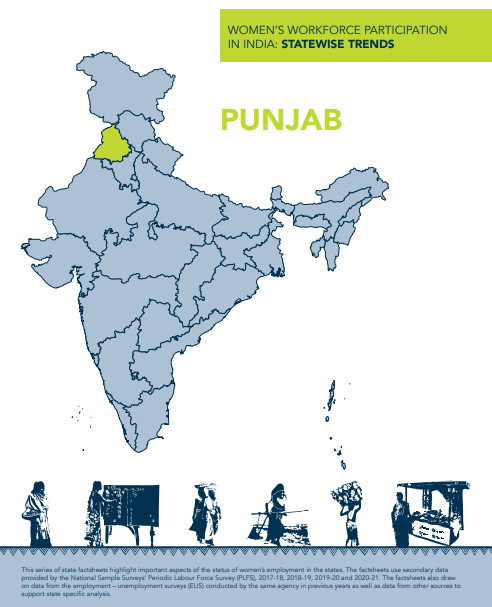
Punjab, a northern state known for its agricultural economy, has a per capita Gross State Domestic Product (GSDP) of INR 1,88,015, higher than the national average. Despite its economic strengths, the state faces challenges in gender equity, with a sex ratio of 891, lower than the national average. Punjab’s Female Labour Force Participation Rate (FLFPR) is also below the national figures, at 19.4% in rural areas and 17.1% in urban areas. However, the state boasts a literacy rate of 75.8%, with minimal gender disparity. This factsheet explores Punjab’s key socio-economic indicators and gender disparities.
Punjab, a northern state known for its agricultural economy, has a per capita Gross State Domestic Product (GSDP) of INR 1,88,015, higher than the national average. Despite its economic strengths, the state faces challenges in gender equity, with a sex ratio of 891, lower than the national average. Punjab’s Female Labour Force Participation Rate (FLFPR) is also below the national figures, at 19.4% in rural areas and 17.1% in urban areas. However, the state boasts a literacy rate of 75.8%, with minimal gender disparity. This factsheet explores Punjab’s key socio-economic indicators and gender disparities.