

This factsheet provides an overview of Jharkhand’s economy, known for its rich mineral resources and industrial hubs like Jamshedpur and Bokaro. While mining is key, agriculture supports over half the population. In 2021-22, the state’s female Work Participation Rate (WPR) stood at 35.2%, largely driven by its tribal communities. Explore Jharkhand’s employment trends and the role of women in its workforce.
Women's Economic
Empowerment
IWWAGE’s work on women’s economic empowerment focuses on understanding and addressing the structural barriers that shape women’s participation in India’s labour market. At the centre of this agenda is the persistently low Female Labour Force Participation Rate (FLFPR), which reflects deep-rooted challenges related to access to decent work, social norms, and labour market institutions.
IWWAGE’s work in this area focuses on:
Evidence generation for policy action
Analysing national and state-level data to understand women’s employment patterns, sectoral and occupational distribution, and barriers to labour market entry and continuity.
Improving measurement and visibility of women’s work
Improved definitions and measurement of work, with a strong emphasis on recognising unpaid, home-based, and care work that remains undercounted in conventional labour statistics.
Shaping the future of women’s work
Examining women’s participation in a rapidly digitising economy, including platform and hybrid work models, to assess emerging opportunities, risks, and forms of precarity.
Strengthening agency and protection
Exploring women’s access to digital skills, agency, bargaining power, and social protection within evolving labour market arrangements.
Together, this body of work highlights that meaningful women’s economic empowerment requires better data, recognition of all forms of work, and the proactive shaping of labour market institutions so that women’s work is visible, valued, and protected.
Learning note
Women’s Workforce Participation in India: Statewise Trends
- April , 2023
- Suchika Gupta , Sona Mitra , Bidisha Mondal
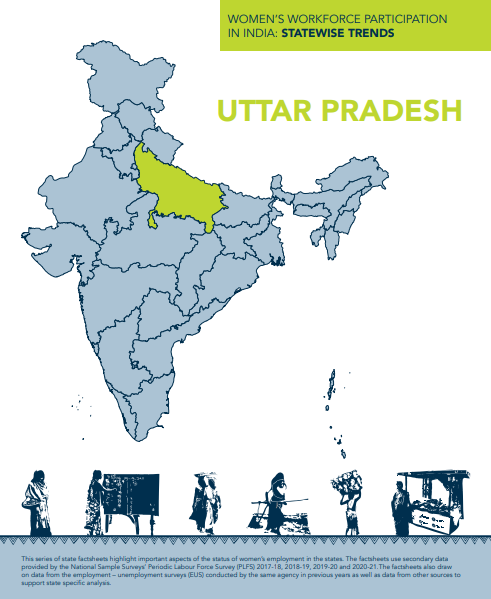
Uttar Pradesh, with a population of nearly 200 million, is India’s most populous state and the fourth largest by area. Despite a literacy rate of 57.1% for women in 2011 and a female unemployment rate of 13.1% in urban areas in 2020-21, UP remains an economic powerhouse. It is the largest producer of food grains and accounts for 90% of India’s carpet production. With a Gross State Domestic Product (GSDP) of INR 17.49 trillion in 2021-22, UP’s economy is driven by its thriving agricultural, textile, and tertiary sectors. This factsheet explores key socio-economic and employment trends in the state.
Uttar Pradesh, with a population of nearly 200 million, is India’s most populous state and the fourth largest by area. Despite a literacy rate of 57.1% for women in 2011 and a female unemployment rate of 13.1% in urban areas in 2020-21, UP remains an economic powerhouse. It is the largest producer of food grains and accounts for 90% of India’s carpet production. With a Gross State Domestic Product (GSDP) of INR 17.49 trillion in 2021-22, UP’s economy is driven by its thriving agricultural, textile, and tertiary sectors. This factsheet explores key socio-economic and employment trends in the state.
Brief
Hybrid Work and its Effect on Women’s Labour Force Participation
- April , 2023
- Areen Deshmukh, Mitali Nikore
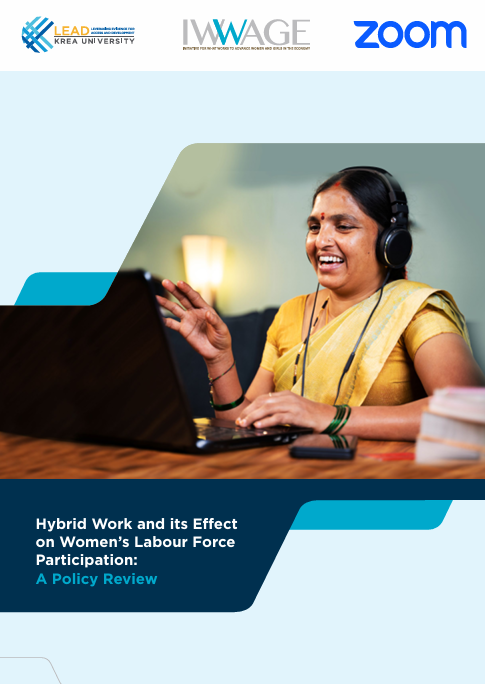
COVID-19 and related lockdowns disrupted the global economy and reshaped the concept of the workplace. Organisations worldwide are increasingly adopting hybrid work models that combine remote and in-office work, a trend also evident in India, where 73% of firms plan to shift to hybrid work (CBRE). Women are more vulnerable to such economic shocks due to structural inequities and their disproportionate burden of unpaid care work, which intensified during the pandemic as care institutions shut down. As a result, women’s employment in India was severely affected, with 13.4 million women (26.6%) exiting the labour force between March–April 2020. Hybrid work offers potential to support women’s labour force participation by providing flexibility for those facing caregiving responsibilities, safety concerns, or mobility constraints. This policy review analyses existing government and private-sector hybrid work policies and identifies global best practices. The study draws on a literature review of policy and legal frameworks across 60 countries, along with consultations with key stakeholders.
COVID-19 and related lockdowns disrupted the global economy and reshaped the concept of the workplace. Organisations worldwide are increasingly adopting hybrid work models that combine remote and in-office work, a trend also evident in India, where 73% of firms plan to shift to hybrid work (CBRE). Women are more vulnerable to such economic shocks due to structural inequities and their disproportionate burden of unpaid care work, which intensified during the pandemic as care institutions shut down. As a result, women’s employment in India was severely affected, with 13.4 million women (26.6%) exiting the labour force between March–April 2020. Hybrid work offers potential to support women’s labour force participation by providing flexibility for those facing caregiving responsibilities, safety concerns, or mobility constraints. This policy review analyses existing government and private-sector hybrid work policies and identifies global best practices. The study draws on a literature review of policy and legal frameworks across 60 countries, along with consultations with key stakeholders.
Factsheet
Women’s Workforce Participation in India: Statewise Trends
- March , 2023
- Trisha Chandra, Sona Mitra
Report
Hybrid Models and Women’s Work in India, Emerging Insights
- March , 2023
- Sona Mitra, Aishwarya Joshi, Mahima Chaki
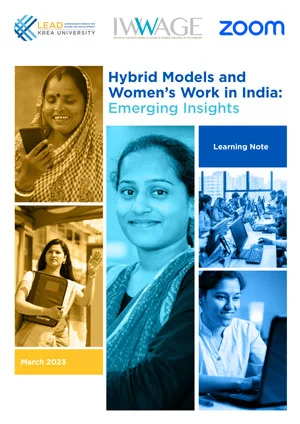
This rapid assessment explores how hybrid work models are reshaping opportunities for women in India post-pandemic. It examines the benefits and challenges of hybrid work, with data from 400 working women across various sectors. Featuring a case study of a rural BPO in Uttarakhand, the study highlights the potential of hybrid work for women in both urban and rural areas, offering insights into its impact on productivity, autonomy, and work-life balance.
Learning note
Women’s Workforce Participation in India: Statewise Trends
- March , 2023
- Trisha Chandra , Sona Mitra , Bidisha Mondal
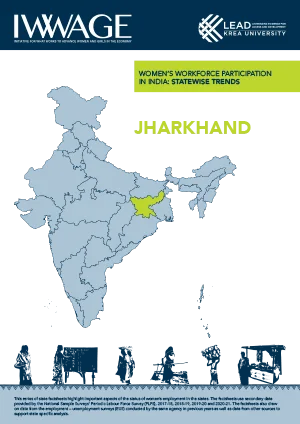
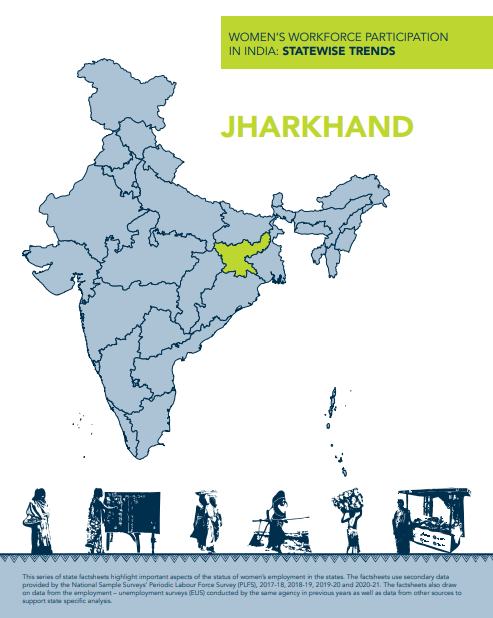
Formed in 2000, Jharkhand is rich in natural resources, covering nearly 80,000 square kilometers with 23,605 sq. km of forest land. The state contributes 40% of India’s total mineral resources, housing major industrial towns like Jamshedpur and Bokaro. While mining and industrial activities are significant, agriculture remains the mainstay for 50.4% of the population. Jharkhand’s female Work Participation Rate (WPR) was 35.2% in 2021-22, driven largely by the state’s tribal population. This factsheet explores Jharkhand’s economy, employment trends, and the role of women in its workforce.
Formed in 2000, Jharkhand is rich in natural resources, covering nearly 80,000 square kilometers with 23,605 sq. km of forest land. The state contributes 40% of India’s total mineral resources, housing major industrial towns like Jamshedpur and Bokaro. While mining and industrial activities are significant, agriculture remains the mainstay for 50.4% of the population. Jharkhand’s female Work Participation Rate (WPR) was 35.2% in 2021-22, driven largely by the state’s tribal population. This factsheet explores Jharkhand’s economy, employment trends, and the role of women in its workforce.
Learning note
Women’s Workforce Participation in India: Statewise Trends
- March , 2023
- Trisha Chandra , Sona Mitra , Bidisha Mondal
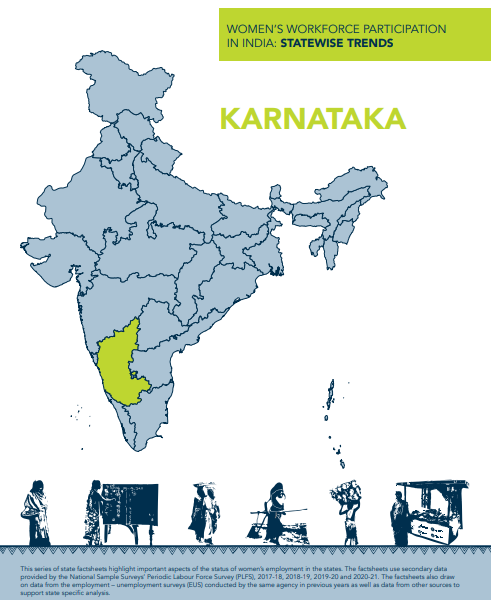
Karnataka, the sixth largest state in India, covers an area of 191,791 square kilometres and has a Gross State Domestic Product (GSDP) of INR 18.85 trillion. Known as India’s leading Information Technology hub, with Bengaluru as the tech capital, Karnataka also has a diverse economy with a strong agricultural base. While over 41% of the workforce depends on agriculture, the services sector contributes 66% to the state’s GSDP. Karnataka boasts one of the highest female labour force participation rates in India, with a Work Participation Rate (WPR) of 31.5% as per the 2021-22 PLFS. Women workers are primarily engaged in agriculture in rural areas and in manufacturing and services in urban regions. This factsheet provides an overview of Karnataka’s socio-economic landscape and workforce trends.
Karnataka, the sixth largest state in India, covers an area of 191,791 square kilometres and has a Gross State Domestic Product (GSDP) of INR 18.85 trillion. Known as India’s leading Information Technology hub, with Bengaluru as the tech capital, Karnataka also has a diverse economy with a strong agricultural base. While over 41% of the workforce depends on agriculture, the services sector contributes 66% to the state’s GSDP. Karnataka boasts one of the highest female labour force participation rates in India, with a Work Participation Rate (WPR) of 31.5% as per the 2021-22 PLFS. Women workers are primarily engaged in agriculture in rural areas and in manufacturing and services in urban regions. This factsheet provides an overview of Karnataka’s socio-economic landscape and workforce trends.