

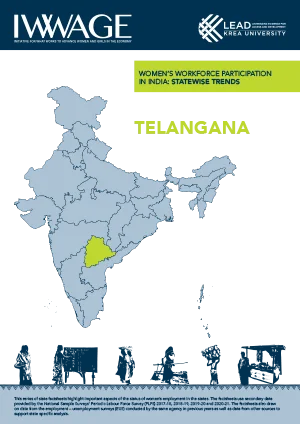
This factsheet highlights Telangana’s rapid economic growth since its formation in 2014, with a per capita income nearly double the national average. While agriculture employs 38% of its population, the services sector drives the state’s economy. Promising progress in education and government initiatives like job reservations and support for Self-Help Groups aim to boost women’s economic empowerment. Explore key socio-economic trends and women’s workforce participation in Telangana.
Women's Economic
Empowerment
IWWAGE’s work on women’s economic empowerment focuses on understanding and addressing the structural barriers that shape women’s participation in India’s labour market. At the centre of this agenda is the persistently low Female Labour Force Participation Rate (FLFPR), which reflects deep-rooted challenges related to access to decent work, social norms, and labour market institutions.
IWWAGE’s work in this area focuses on:
Evidence generation for policy action
Analysing national and state-level data to understand women’s employment patterns, sectoral and occupational distribution, and barriers to labour market entry and continuity.
Improving measurement and visibility of women’s work
Improved definitions and measurement of work, with a strong emphasis on recognising unpaid, home-based, and care work that remains undercounted in conventional labour statistics.
Shaping the future of women’s work
Examining women’s participation in a rapidly digitising economy, including platform and hybrid work models, to assess emerging opportunities, risks, and forms of precarity.
Strengthening agency and protection
Exploring women’s access to digital skills, agency, bargaining power, and social protection within evolving labour market arrangements.
Together, this body of work highlights that meaningful women’s economic empowerment requires better data, recognition of all forms of work, and the proactive shaping of labour market institutions so that women’s work is visible, valued, and protected.
Brief
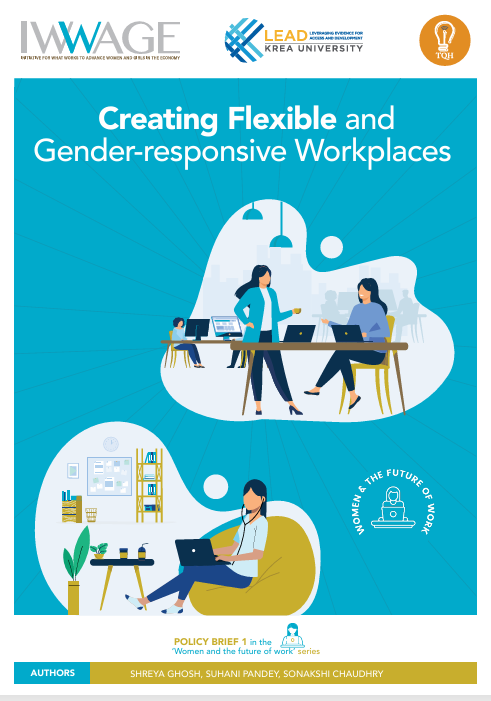
Creating Flexible and Gender-responsive Workplaces
- March , 2023
- Shreya Ghosh | Suhani Pandey | Sonakshi Chaudhary
The COVID-19 pandemic triggered a significant shift in the ‘future of work,’ with remote work rapidly becoming a global norm. In India, this shift was accompanied by a gendered impact-women faced higher job losses and slower recovery rates than men, particularly among the highly educated. Despite challenges such as lack of infrastructure and fear of career setbacks, there is a growing demand among women for flexible work arrangements. Studies show that 8 in 10 women in India now prefer greater workplace flexibility, underscoring the need for gender-responsive remote work policies. Recognising these trends, the Government of India, along with several state governments, has initiated efforts to create remote work ecosystems, including ‘Work Near Home’ centres and co-working spaces. These initiatives, especially in the services sector like IT/ITES-which employs over 4.7 million people with 35% female representation-offer a unique opportunity to boost women’s labour force participation. However, for such models to be inclusive and scalable, they must incorporate thoughtful design principles that address sector-specific challenges and prioritise women’s needs for safety, infrastructure, and digital access.
The COVID-19 pandemic triggered a significant shift in the ‘future of work,’ with remote work rapidly becoming a global norm. In India, this shift was accompanied by a gendered impact-women faced higher job losses and slower recovery rates than men, particularly among the highly educated. Despite challenges such as lack of infrastructure and fear of career setbacks, there is a growing demand among women for flexible work arrangements. Studies show that 8 in 10 women in India now prefer greater workplace flexibility, underscoring the need for gender-responsive remote work policies. Recognising these trends, the Government of India, along with several state governments, has initiated efforts to create remote work ecosystems, including ‘Work Near Home’ centres and co-working spaces. These initiatives, especially in the services sector like IT/ITES-which employs over 4.7 million people with 35% female representation-offer a unique opportunity to boost women’s labour force participation. However, for such models to be inclusive and scalable, they must incorporate thoughtful design principles that address sector-specific challenges and prioritise women’s needs for safety, infrastructure, and digital access.
Report
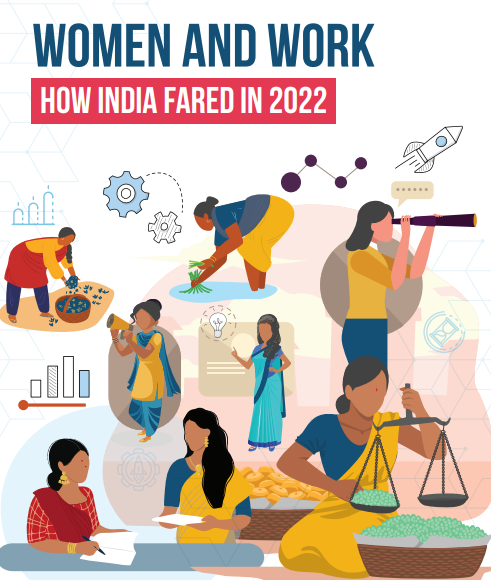
Women and Work, How India Fared in 2022
- February , 2023
- IWWAGE , TQH
2022 presented a landscape of change as the world aimed for greater resilience, recovery and growth as things began to open up post the COVID-19 pandemic. Spurred by changes in the overall outlook on work, women’s participation in the workforce also reflected a shift, with remote and hybrid work emerging strongly in certain sectors, in continuation of trends set during the height of the pandemic. Similarly, even in work that cannot be performed remotely, there has been a deepening in positive trends. As lockdowns lifted, women persondays in certain employment schemes also climbed. Against this backdrop, India has assumed the G20 presidency for 2023, and the year provides the nation with the opportunity to not only proactively set the agenda for women-led development, but also plan for the next phase of growth. There is thus a need to provide a roadmap for enablers of women-led development, whether through participation in leadership, reflection in policy mandates, or even addressing barriers to work. From the macro-political economic scenario to the specific challenges faced by women, this report situates women’s work against the challenges and opportunities that lie ahead, particularly in light of India’s G20 presidency. Threaded through with insights from IWWAGE and LEAD’s research on the subject, the report covers trends across available data sources on scheme performances, policy changes, and political announcements, mapping the contours of women’s work in India and looking ahead to 2023.
2022 presented a landscape of change as the world aimed for greater resilience, recovery and growth as things began to open up post the COVID-19 pandemic. Spurred by changes in the overall outlook on work, women’s participation in the workforce also reflected a shift, with remote and hybrid work emerging strongly in certain sectors, in continuation of trends set during the height of the pandemic. Similarly, even in work that cannot be performed remotely, there has been a deepening in positive trends. As lockdowns lifted, women persondays in certain employment schemes also climbed. Against this backdrop, India has assumed the G20 presidency for 2023, and the year provides the nation with the opportunity to not only proactively set the agenda for women-led development, but also plan for the next phase of growth. There is thus a need to provide a roadmap for enablers of women-led development, whether through participation in leadership, reflection in policy mandates, or even addressing barriers to work. From the macro-political economic scenario to the specific challenges faced by women, this report situates women’s work against the challenges and opportunities that lie ahead, particularly in light of India’s G20 presidency. Threaded through with insights from IWWAGE and LEAD’s research on the subject, the report covers trends across available data sources on scheme performances, policy changes, and political announcements, mapping the contours of women’s work in India and looking ahead to 2023.
Factsheet
Women’s Workforce Participation in India: Statewise Trends
- January , 2023
- Suchika Gupta, Bidisha Mondal
This factsheet provides an overview of Punjab’s socio-economic landscape, highlighting its strong per capita GSDP but ongoing gender challenges. Despite a high literacy rate of 75.8%, the state’s Female Labour Force Participation Rate (FLFPR) remains below national averages, with 19.4% in rural areas and 17.1% in urban areas. Explore the key gender disparities and socio-economic trends shaping Punjab’s development.
This factsheet provides an overview of Punjab’s socio-economic landscape, highlighting its strong per capita GSDP but ongoing gender challenges. Despite a high literacy rate of 75.8%, the state’s Female Labour Force Participation Rate (FLFPR) remains below national averages, with 19.4% in rural areas and 17.1% in urban areas. Explore the key gender disparities and socio-economic trends shaping Punjab’s development.
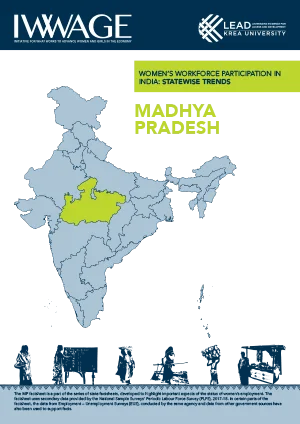
Factsheet
Women’s Workforce Participation in India: Statewise Trends
- January , 2023
- Prakriti Sharma, Sona Mitra
Factsheet
Women’s Workforce Participation in India: Statewise Trends
- January , 2023
- Nidhi Gyan Pandey
This factsheet highlights Assam’s key socio-economic indicators, including a Female Labour Force Participation (FLFP) rate of 18.9% in rural areas and 16% in urban areas, both below the national average. With a literacy rate of 72.2%, the state shows notable gender disparity in education. Explore Assam’s economic landscape, gender ratios, and workforce trends.
This factsheet highlights Assam’s key socio-economic indicators, including a Female Labour Force Participation (FLFP) rate of 18.9% in rural areas and 16% in urban areas, both below the national average. With a literacy rate of 72.2%, the state shows notable gender disparity in education. Explore Assam’s economic landscape, gender ratios, and workforce trends.
Factsheet
Women’s Workforce Participation in India: Statewise Trends
- January , 2023
- Prakriti Sharma, Sona Mitra
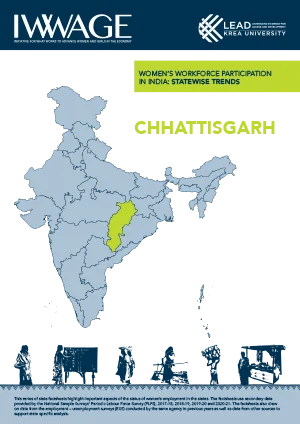
This factsheet provides insights into Chhattisgarh’s socio-economic trends, highlighting its strong Female Work Participation Rate (FWPR), which is 17 percentage points above the national average. Known as the ‘rice bowl of India,’ with 70% of its workforce in agriculture, Chhattisgarh has also made progress in reducing multi-dimensional poverty. Explore key data on women’s employment and the agricultural sector in the state.