

Women's Economic
Empowerment

IWWAGE’s work on women’s economic empowerment focuses on understanding and addressing the structural barriers that shape women’s participation in India’s labour market. At the centre of this agenda is the persistently low Female Labour Force Participation Rate (FLFPR), which reflects deep-rooted challenges related to access to decent work, social norms, and labour market institutions.

IWWAGE’s work in this area focuses on:

Evidence generation for policy action

Analysing national and state-level data to understand women’s employment patterns, sectoral and occupational distribution, and barriers to labour market entry and continuity.

Improving measurement and visibility of women’s work

Improved definitions and measurement of work, with a strong emphasis on recognising unpaid, home-based, and care work that remains undercounted in conventional labour statistics.

Shaping the future of women’s work

Examining women’s participation in a rapidly digitising economy, including platform and hybrid work models, to assess emerging opportunities, risks, and forms of precarity.

Strengthening agency and protection

Exploring women’s access to digital skills, agency, bargaining power, and social protection within evolving labour market arrangements.

Together, this body of work highlights that meaningful women’s economic empowerment requires better data, recognition of all forms of work, and the proactive shaping of labour market institutions so that women’s work is visible, valued, and protected.
IWWAGE-ISI-BRIEFS

Social Identities and Female Labour Force Participation in India

This brief compiles evidence and data to assess whether caste-based discrimination in India reinforces women’s already disadvantaged position in the labour force. It examines trends in women’s labour force participation by caste, using the official administrative definitions of Scheduled Castes (SCs) and Scheduled Tribes (STs) from major government datasets.
Compendium of best practices

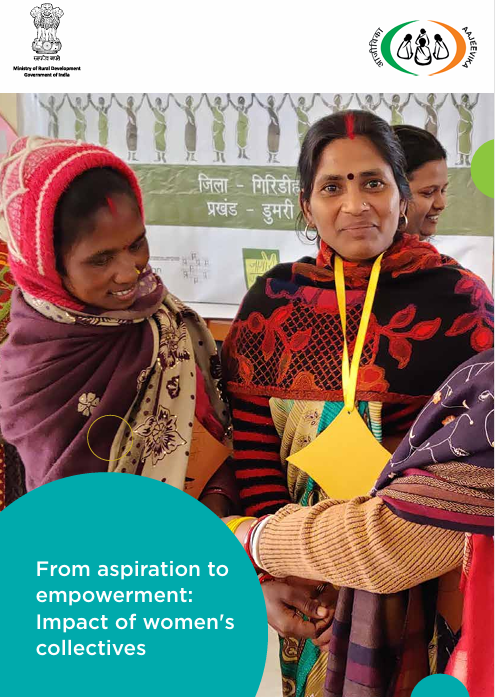
From aspiration to empowerment: Impact of women’s collectives

The Deendayal Antyodaya Yojana- National Rural Livelihoods Mission (DAY NRLM) has adopted a focussed approach towards gender mainstreaming in its programme architecture. This includes establishing institutional mechanisms like Social Action Committees at the village organisation (VO SAC) and cluster federation levels to serve as response mechanisms to various issues that women and girls face, and that continue to act as barriers for them in accessing their rights and entitlements to lead a decent living. These Social Action Committees have shown exemplary leadership in strengthening the gender responsiveness of the programme at the grassroots level, especially during COVID-19. The compendium on best practices titled, From aspiration to empowerment: Impact of women’s collectives, was launched in the presence of Sadhvi Niranjan Jyoti, Minister of State, Rural Development, officials from the Ministry of Rural Development and all State Governments through an online event, national webinar on sharing of best practices adopted for addressing gender issues by VO SACs held on June 29, 2021. The compendium of case studies from 23 States highlights the processes, mechanisms, strategies and plans for replicating and scaling gender interventions to advance gender equality and end all forms of discrimination against women and girls. This volume contains inspiring stories of VO-SACs in increasing women’s access to rights and entitlements, and other economic issues like addressing wage disparities between men and women in the village through collective action; addressing issues of drudgery; the labour rights of migrants, prevention of child marriage, increasing girls retention in schools, preventing child abuse, alcoholism, domestic violence, witch hunting, human trafficking, and COVID-related gender issues. Broadly, the case studies highlight how VO-SACs have used multiple strategies including restorative justice, collective action, offering support to women (including psycho-social support) and sometimes even engaging with men to address issues that matter to women.
Working Paper

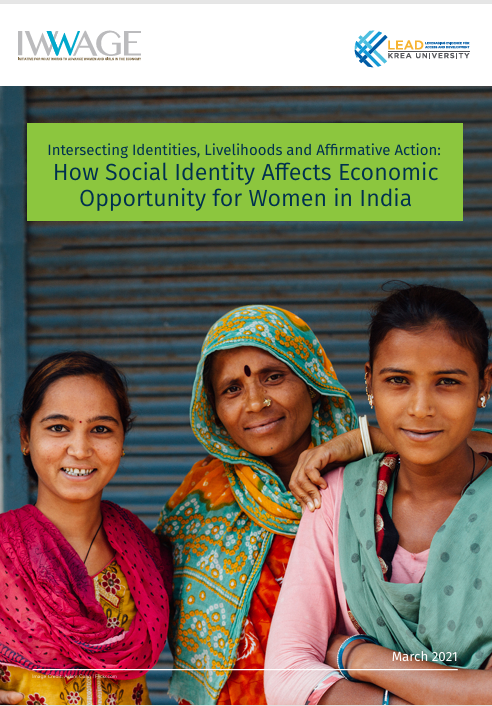
Intersecting Identities, Livelihoods and Affirmative Action: How Social Identity Affects Economic Opportunity for Women in India

This paper presents a landscape assessment of the current state of gender inequality in the economic sphere in India, which is a key facet of overall inequality. The assessment comprises the latest empirical evidence based both on demographic survey data, as well as key results from cutting-edge scholarly literature. Male “female gaps are significant in many dimensions, but the contours of these gaps are shaped by the overlap of gender with other social identities, such as caste, religion or tribal identities. Thus, women from stigmatised and marginalised groups are disadvantaged along two dimensions and have to battle the double stigma of this intersectionality. The paper outlines the trends in overall gender gaps in the areas of labour force participation, self-employment and education over the last couple of decades, but highlights the role of intersectionality that goes into producing structures of advantage and disadvantage. The paper discusses policies such as the National Rural Livelihood Mission designed to encourage self-employment, which have had several other positive impacts, such as increase in empowerment and autonomy, but their record in terms of enhancing livelihoods is mixed at best. Evidence shows that policies such as employment guarantee schemes or transport infrastructure could end up having positive gendered effects, despite their gender-blind design. The paper argues that in order to tackle inequality fundamentally, we need to mainstream evidence-based research on intersectionality, which should be the basic lens informing policy.
Brief

COVID-19 and Women’s Labour Crisis

A pandemic that translates itself into an economic crisis has the potential to push women out of the labour force through several mechanisms. An economic crisis creates pressure on governments to cut down on social sector expenditures which potentially increases the burden of unpaid care and household work for women. As a result, women’s time for engaging in productive work gets reduced, having a negative impact on their labour force participation. The COVID-19 pandemic in India has had an unequal impact on women in a number of ways. In terms of economic opportunity, it has been seen that more women lost jobs compared to men and fewer have been able to rejoin labour force. This is in the context of gendered labour markets where female labour force participation has been low and declining. This paper presents an analysis of the situation of women’s employment pre-lockdown and some indications on what the impact of COVID-19 could be, based on microstudies and other literature available. Further, the adequacy of the social protection and employment generation programmes of the government that are specifically aimed at improving female labour force participation is assessed.
Learning note

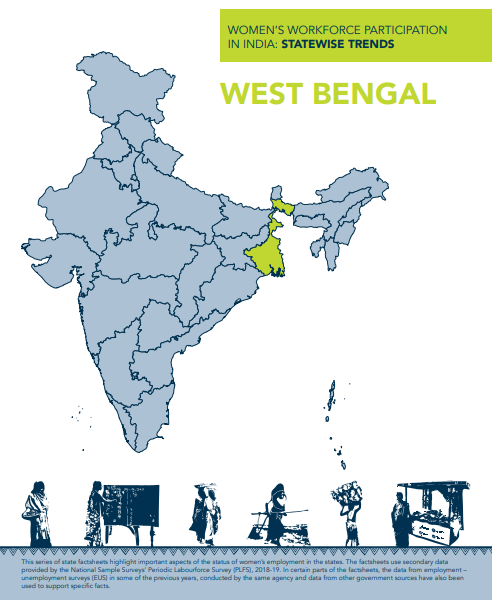
Women’s Workforce Participation in India: Statewise Trends

West Bengal, home to 99 million people, is the fourth most populous state in India. With a primarily rural population and agriculture as the main source of employment, women’s work participation rates remain low. Many women in rural areas engage in unpaid agricultural labor, particularly in paddy fields, leading to underreporting of their contributions. The state’s female labour force participation rate (FLFPR) is 17.5%, below the national average. Despite challenges, West Bengal shows strong performance in indicators like maternal mortality and sex ratio, though issues like gender inequality in the labour market and high rates of under-nutrition persist.
Factsheet

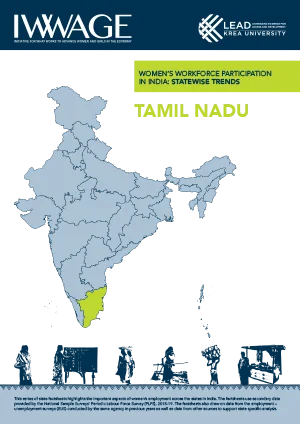
Women’s Workforce Participation in India: Statewise Trends

This factsheet highlights Tamil Nadu’s strong economy, with a GSDP of Rs 18,45,853 crores, and impressive social development. The state ranks third in human development and boasts high female labour force participation rates (rural: 35.1%, urban: 23.6%) along with excellent gender indicators, including a low maternal mortality rate and one of the lowest crime rates against women in India.
Scroll to Top