

Women's Economic
Empowerment

IWWAGE’s work on women’s economic empowerment focuses on understanding and addressing the structural barriers that shape women’s participation in India’s labour market. At the centre of this agenda is the persistently low Female Labour Force Participation Rate (FLFPR), which reflects deep-rooted challenges related to access to decent work, social norms, and labour market institutions.

IWWAGE’s work in this area focuses on:

Evidence generation for policy action

Analysing national and state-level data to understand women’s employment patterns, sectoral and occupational distribution, and barriers to labour market entry and continuity.

Improving measurement and visibility of women’s work

Improved definitions and measurement of work, with a strong emphasis on recognising unpaid, home-based, and care work that remains undercounted in conventional labour statistics.

Shaping the future of women’s work

Examining women’s participation in a rapidly digitising economy, including platform and hybrid work models, to assess emerging opportunities, risks, and forms of precarity.

Strengthening agency and protection

Exploring women’s access to digital skills, agency, bargaining power, and social protection within evolving labour market arrangements.

Together, this body of work highlights that meaningful women’s economic empowerment requires better data, recognition of all forms of work, and the proactive shaping of labour market institutions so that women’s work is visible, valued, and protected.
Report

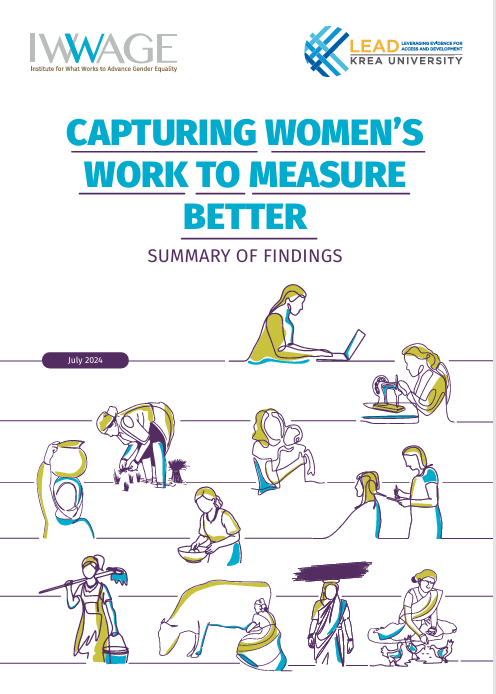
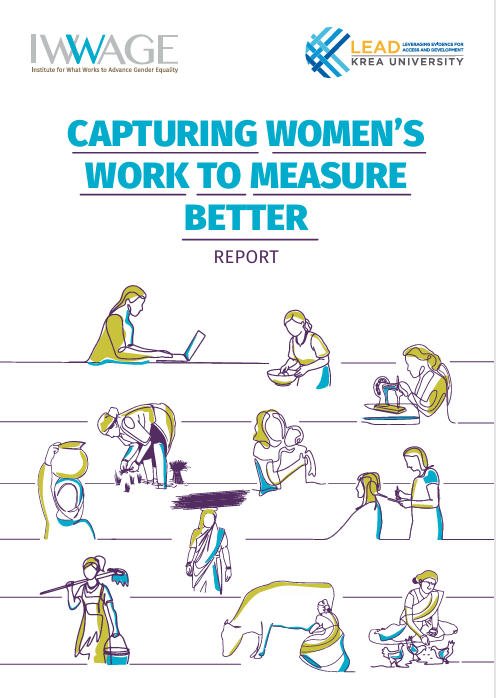
Capturing Women’s Work to Measure Better

Women’s work is often underestimated in labour force surveys due to its complex nature, which includes economic, non-economic, and unpaid work such as domestic tasks and caregiving. Additionally, biases in respondents and enumerators, along with survey designs lacking gender sensitivity, contribute to data gaps and the undercounting of women’s contributions, keeping them invisible in statistics and policy discussions. Research highlights how oversimplified methodologies in mainstream surveys lead to the misclassification of economically active women as inactive. This study aims to address these gaps by testing innovative survey techniques that provide more accurate estimates of women’s participation in the workforce. It also examines perception bias in proxy-reporting. The study was conducted in Karnataka and Jharkhand, surveying 4,000 women and 800 men. Findings show that these innovations were effective in capturing more women in employment compared to conventional surveys, offering deeper insights into their time-use patterns and highlighting the impact of perception bias in proxy reporting.
Learning note

Capturing Women’s Work To Measure Better

Women’s work is often more diverse and complex due to the significant amount of unpaid labour they perform, including domestic chores and caregiving responsibilities. Conventional labour force surveys tend to overlook these contributions, leading to an undercounting of women’s work and their exclusion from policy discussions. As a result, women are often not recognised as ‘workers,’ keeping them invisible in statistical estimates. IWWAGE seeks to address this gap by developing better mechanisms for collecting data on women’s work. Through innovative probing techniques and sampling frames, our research aims to capture a more accurate picture of women’s labour force participation. Additionally, we propose a framework for women-centric surveys that can be aligned with national Labour Force Surveys (LFS) to provide more accurate estimates. Our study also highlights the bias that occurs when respondents other than women themselves report on their work, further underestimating women’s contributions to the economy. By engendering labour force surveys, IWWAGE hopes to bring greater visibility to women’s work and ensure their inclusion in policy discussions that drive economic empowerment.
Report

IWWAGE Trends Report 2023

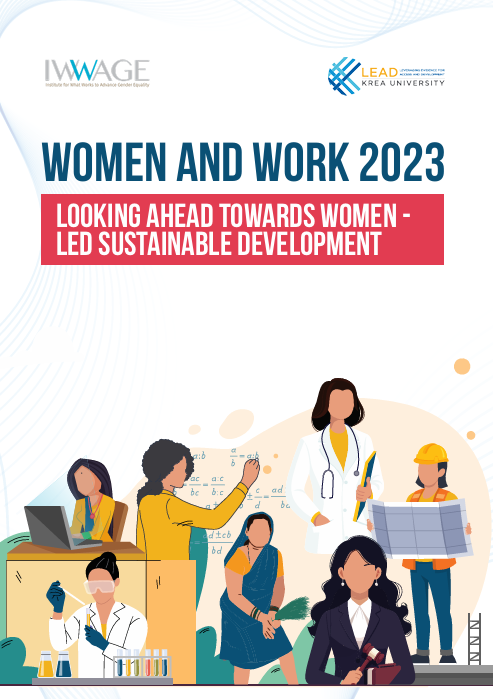
This report contextualises women’s participation in various fields within the broader political and economic landscape of 2023. It highlights the challenges and opportunities that emerged during the year and offers a forward-looking perspective on potential growth areas in 2024, recognising women as a formidable force in driving progress and prosperity.
Report

IWWAGE Women And Work Trends Report 2023

In 2023, India emerged as the fastest-growing major economy globally, driven by robust employment generation, productivity gains, and sustained economic growth. Alongside this remarkable economic performance, the year brought women-led development and Nari Shakti into focus, reaffirming India’s commitment to gender equality and sustainable development. However, despite these advancements, the issue of female labour force participation remains critical. India has long struggled with lower female labour force participation compared to global standards, with socio-economic and cultural factors limiting the full utilisation of women’s potential. Yet, recent trends offer promising signs of progress. According to the latest Periodic Labour Force Survey (2022-2023), female participation in the labour force for those aged 15 and above rose to 37%, with rural areas seeing an increase from 36.6% to 41.5%, and urban areas from 23.8% to 25.4%. More women are engaging in family-owned or self-employed work, including agriculture, contributing positively to this shift. Additionally, 2023 witnessed significant strides towards women-led development, with a renewed push for women’s representation in Parliament and proactive policy discussions during India’s G-20 presidency. However, the journey towards true gender equality remains ongoing. Women continue to be under-represented in key sectors, particularly in science and technology, with workplaces reflecting broader economic and social inequalities. India’s G-20 presidency adopted a gender-focused approach, aiming to reposition women not just as beneficiaries but as economic agents driving development. By embracing women-led development, India sought to shift the narrative and demonstrate the transformative potential of women in spearheading key sectors and promoting inclusive growth. This report contextualises women’s participation in various fields within the broader political and economic landscape of 2023. It highlights the challenges and opportunities that emerged during the year and offers a forward-looking perspective on potential growth areas in 2024, recognising women as a formidable force in driving progress and prosperity.
Learning note

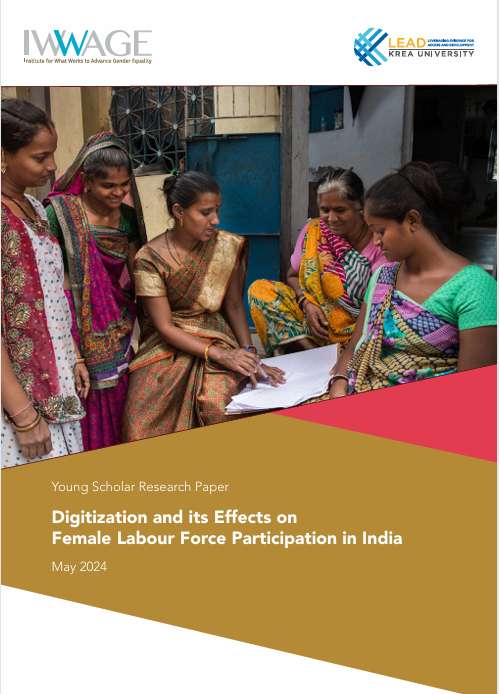
Digitization and its Effects on Female Labour Force Participation in India

India has witnessed a manifold increase in awareness and accessibility of job opportunities thanks to an increase in digitisation in all sectors. Technology has created new jobs and has made old jobs more accessible and convenient. Remote work opportunities, online training modules, and networking have become easier due to the internet, but its benefits are skewed. This paper explores the impact of increasing digitisation on female labour force participation (FLFP). Digitalisation is associated with improving gender outcomes, alongside various socio-economic factors. Research highlights how increasing the use of digital finance, improved digital infrastructure and digital awareness has a strong positive and significant correlation with FLFP. The paper investigates opportunities provided by digitalisation for enhancing women’s economic contribution and empowerment in both rural and urban settings.
Report

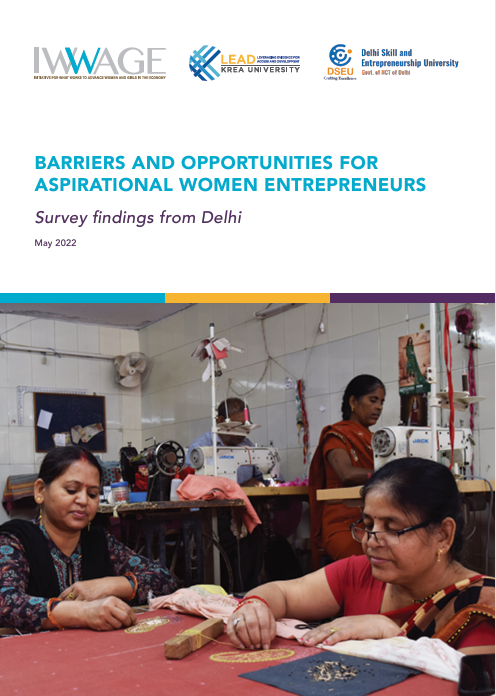
Barriers & Opportunities For Aspirational Women Entrepreneurs

This study, conducted in partnership with the Delhi Skill and Entrepreneurship University (DSEU) and the Government of NCT of Delhi, assesses the enterprise readiness of women across five Anganwadi Hubs (AWHs) in the city under the Saheli Samanvay Kendra (SSK) Scheme. Drawing from both quantitative and qualitative data, it explores the demographic profile, motivations, aspirations, and challenges of women’s particularly housewives, unemployed individuals, and informal worker’s seeking to engage in entrepreneurial activities. The findings highlight the critical need for targeted support, especially around access to finance, confidence building, and balancing domestic responsibilities with business pursuits. The study also captures a strong appetite for skill development, with women expressing interest in both technical and soft skills training, particularly if offered at familiar, community-based locations like Anganwadi Centres. These insights directly inform the design of training programmes and the structure of a dedicated fellowship module under the SSK Scheme, which aims to mobilise and mentor women entrepreneurs. The report offers practical recommendations for policymakers and training institutions, underscoring the potential of structured, accessible interventions to advance women’s economic empowerment at the grassroots level.
Scroll to Top