

Care Economy

Women’s low labour force participation in India is closely linked to the unequal burden of unpaid care and domestic work. Evidence from India’s Time Use Survey shows that women and girls spend significantly more time on unpaid household and caregiving responsibilities than men and boys, while paid care work remains largely feminised, undervalued, and characterised by low wages and limited social protection. Addressing the care economy is therefore critical to advancing women’s economic participation and building inclusive labour markets.

IWWAGE’s work on the care economy focuses on:

Building evidence through collaboration

Generating and co-creating policy-relevant evidence in partnership with research institutions, governments, and civil society to highlight the scale, value, and distribution of care work.

Strengthening care and social infrastructure

Advocating investments in care services and enabling infrastructure such as childcare, elder care, piped water, clean energy, and reliable electricity to reduce women’s unpaid care burden.

Improving measurement and visibility of care work

Advancing better tools and methods to measure unpaid and paid care work, ensuring women’s contributions are visible in data, policy, and planning processes.

Advancing rights and protections for care workers

Supporting policy dialogue on fair wages, social protection, and access to entitlements for paid care workers.

Influencing policy and advocacy

Using evidence to inform policy across national and sub-national levels through sustained engagement with key institutions, including NITI Aayog, the Ministry of Women and Child Development, and the Ministry of Rural Development.

This body of work has strengthened national and international attention to care workers’ needs, including during India’s G20 Presidency in 2023, and contributed to IWWAGE being recognised by UNESCAP and UN Women (Regional Office) as a Care Champion in the region for 2024.
Brief

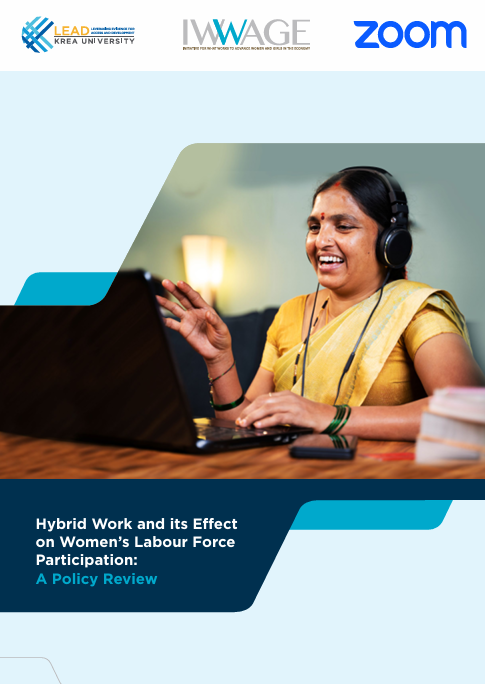
Hybrid Work and its Effect on Women’s Labour Force Participation

COVID-19 and related lockdowns disrupted the global economy and reshaped the concept of the workplace. Organisations worldwide are increasingly adopting hybrid work models that combine remote and in-office work, a trend also evident in India, where 73% of firms plan to shift to hybrid work (CBRE). Women are more vulnerable to such economic shocks due to structural inequities and their disproportionate burden of unpaid care work, which intensified during the pandemic as care institutions shut down. As a result, women’s employment in India was severely affected, with 13.4 million women (26.6%) exiting the labour force between March–April 2020. Hybrid work offers potential to support women’s labour force participation by providing flexibility for those facing caregiving responsibilities, safety concerns, or mobility constraints. This policy review analyses existing government and private-sector hybrid work policies and identifies global best practices. The study draws on a literature review of policy and legal frameworks across 60 countries, along with consultations with key stakeholders.
Brief

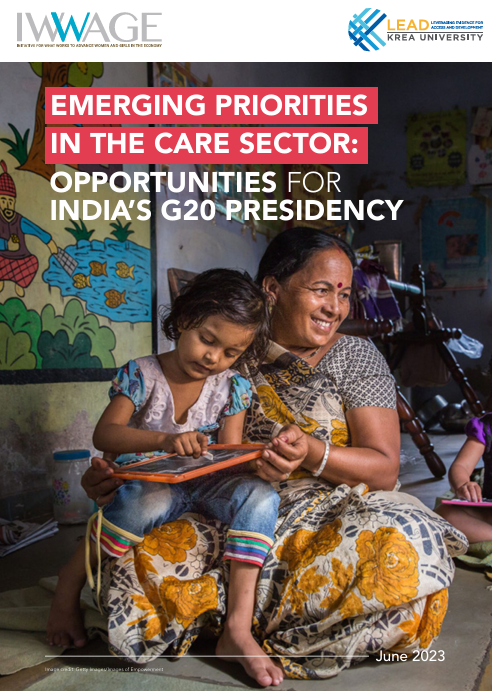
Emerging Priorities in the Care Sector: Opportunities for India’s G20 Presidency

Care work has emerged as a critical issue in shaping the women-led development agenda at the G20. This brief highlights priority concerns for India’s G20 presidency. Care work—both paid and unpaid—is essential to the functioning of economies and societies, yet it is disproportionately shouldered by women due to entrenched gender norms and the gendered division of labour. This unequal burden remains a major barrier to women’s participation in labour markets. Evidence shows that care responsibilities significantly limit women’s income-earning capacity and economic agency, with women globally spending two to ten times more time on unpaid care work than men.
Brief

Creating Flexible and Gender-responsive Workplaces

The COVID-19 pandemic triggered a significant shift in the ‘future of work,’ with remote work rapidly becoming a global norm. In India, this shift was accompanied by a gendered impact-women faced higher job losses and slower recovery rates than men, particularly among the highly educated. Despite challenges such as lack of infrastructure and fear of career setbacks, there is a growing demand among women for flexible work arrangements. Studies show that 8 in 10 women in India now prefer greater workplace flexibility, underscoring the need for gender-responsive remote work policies. Recognising these trends, the Government of India, along with several state governments, has initiated efforts to create remote work ecosystems, including ‘Work Near Home’ centres and co-working spaces. These initiatives, especially in the services sector like IT/ITES-which employs over 4.7 million people with 35% female representation-offer a unique opportunity to boost women’s labour force participation. However, for such models to be inclusive and scalable, they must incorporate thoughtful design principles that address sector-specific challenges and prioritise women’s needs for safety, infrastructure, and digital access.
Learning note

Gender Responsive Budgeting: Good Practices from Select States

Mainstreaming gender into development financing has gained global momentum, with the Addis Ababa Action Agenda reinforcing the need for gender-sensitive approaches in financial, economic, and social policies. In India, the journey towards Gender Responsive Budgeting (GRB) began with efforts in the Sixth Five Year Plan and was institutionalised at the central level in 2004-05. GRB aims to integrate gender considerations across development planning, programme formulation, and budgeting processes. India’s GRB mechanism functions through Gender Budget Cells and the Gender Budget Statement (GBS), covering 57 ministries as of 2022. While the framework provides an avenue for monitoring fund allocations and their impact on gender equality, significant gaps remain in its implementation. State governments, such as Odisha and Kerala, have shown greater success in embedding gender concerns into policy-making, with Odisha allocating over 40% of its budget towards gender priorities. However, at the national level, gender budgeting remains low, accounting for less than 5% of the Union Budget. This brief highlights the divrse approaches to GRB across states like Odisha, Karnataka, Kerala, and Andhra Pradesh, showcasing experiences, lessons learnt, and good practices in advancing gender equality through fiscal policy.
Report

Women and Work, How India Fared in 2022

2022 presented a landscape of change as the world aimed for greater resilience, recovery and growth as things began to open up post the COVID-19 pandemic. Spurred by changes in the overall outlook on work, women’s participation in the workforce also reflected a shift, with remote and hybrid work emerging strongly in certain sectors, in continuation of trends set during the height of the pandemic. Similarly, even in work that cannot be performed remotely, there has been a deepening in positive trends. As lockdowns lifted, women persondays in certain employment schemes also climbed. Against this backdrop, India has assumed the G20 presidency for 2023, and the year provides the nation with the opportunity to not only proactively set the agenda for women-led development, but also plan for the next phase of growth. There is thus a need to provide a roadmap for enablers of women-led development, whether through participation in leadership, reflection in policy mandates, or even addressing barriers to work. From the macro-political economic scenario to the specific challenges faced by women, this report situates women’s work against the challenges and opportunities that lie ahead, particularly in light of India’s G20 presidency. Threaded through with insights from IWWAGE and LEAD’s research on the subject, the report covers trends across available data sources on scheme performances, policy changes, and political announcements, mapping the contours of women’s work in India and looking ahead to 2023.
Scroll to Top