

Women's Economic
Empowerment
IWWAGE’s work on women’s economic empowerment focuses on understanding and addressing the structural barriers that shape women’s participation in India’s labour market. At the centre of this agenda is the persistently low Female Labour Force Participation Rate (FLFPR), which reflects deep-rooted challenges related to access to decent work, social norms, and labour market institutions.
IWWAGE’s work in this area focuses on:
Evidence generation for policy action
Analysing national and state-level data to understand women’s employment patterns, sectoral and occupational distribution, and barriers to labour market entry and continuity.
Improving measurement and visibility of women’s work
Improved definitions and measurement of work, with a strong emphasis on recognising unpaid, home-based, and care work that remains undercounted in conventional labour statistics.
Shaping the future of women’s work
Examining women’s participation in a rapidly digitising economy, including platform and hybrid work models, to assess emerging opportunities, risks, and forms of precarity.
Strengthening agency and protection
Exploring women’s access to digital skills, agency, bargaining power, and social protection within evolving labour market arrangements.
Together, this body of work highlights that meaningful women’s economic empowerment requires better data, recognition of all forms of work, and the proactive shaping of labour market institutions so that women’s work is visible, valued, and protected.
Brief
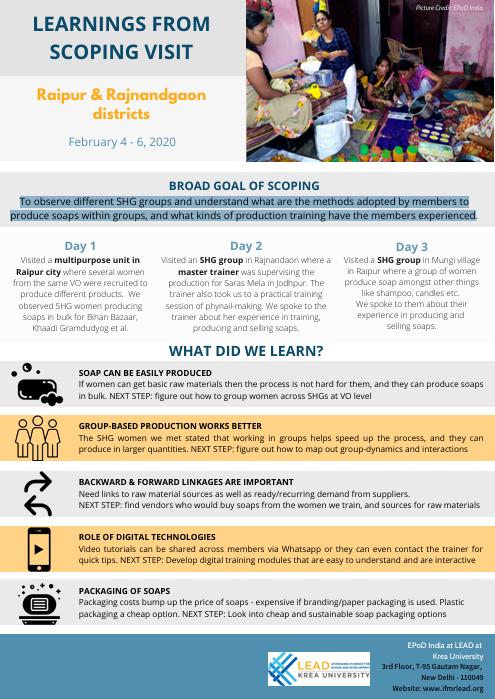
Learnings from Scoping Visit
- February , 2020
To observe different SHG groups and understand what are the methods adopted by members to produce soaps within groups, and what kinds of production training have the members experienced
To observe different SHG groups and understand what are the methods adopted by members to produce soaps within groups, and what kinds of production training have the members experienced
Learning note
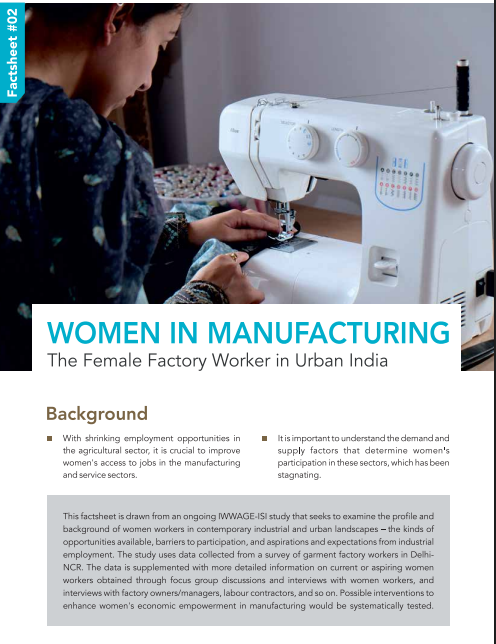
Women in Manufacturing
- February , 2020
This factsheet is drawn from an IWWAGE-ISI study that seeks to examine the profile and background of women workers in contemporary industrial and urban landscapes – the kinds of opportunities available, barriers to participation, and aspirations and expectations from industrial employment. The study uses data collected from a survey of garment factory workers in Delhi-NCR. The data is supplemented with more detailed information on current or aspiring women workers obtained through focus group discussions and interviews with women workers, and interviews with factory owners/managers, labour contractors, and so on. Possible interventions to enhance women’s economic empowerment in manufacturing would be systematically tested.
This factsheet is drawn from an IWWAGE-ISI study that seeks to examine the profile and background of women workers in contemporary industrial and urban landscapes – the kinds of opportunities available, barriers to participation, and aspirations and expectations from industrial employment. The study uses data collected from a survey of garment factory workers in Delhi-NCR. The data is supplemented with more detailed information on current or aspiring women workers obtained through focus group discussions and interviews with women workers, and interviews with factory owners/managers, labour contractors, and so on. Possible interventions to enhance women’s economic empowerment in manufacturing would be systematically tested.
Brief
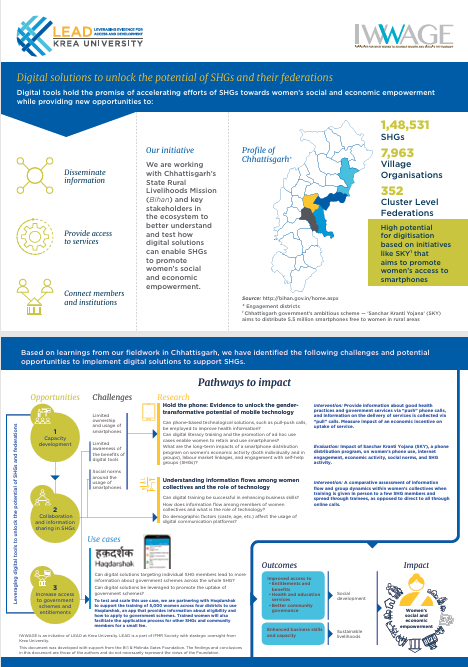
Digital Solutions to Unlock the Potential of SHGs and their Federations
- January , 2020
IWWAGE – an initiative of LEAD at Krea University– in partnership with the State Rural Livelihoods Mission (SRLM) Chhattisgarh and Haqdarshak Empowerment Solutions, is implementing a project that trains women self-help group (SHG) members as Haqdarshikas to provide doorstep access to government welfare schemes using a mobile app, Haqdarshak. A survey of 411 Haqdarshikas conducted in late 2020 revealed that while many continued to support their communities, a large number had stopped using the app, citing issues such as smartphone access, digital literacy, and low demand for services. Despite challenges, 97% of respondents reported earning income through paid work, and most remained engaged in the program, motivated by community recognition, learning, and income opportunities. The study highlights both the potential and challenges of leveraging SHG women as digital agents for last-mile delivery of entitlements and offers insights for improving retention, support, and impact of such models.
IWWAGE – an initiative of LEAD at Krea University– in partnership with the State Rural Livelihoods Mission (SRLM) Chhattisgarh and Haqdarshak Empowerment Solutions, is implementing a project that trains women self-help group (SHG) members as Haqdarshikas to provide doorstep access to government welfare schemes using a mobile app, Haqdarshak. A survey of 411 Haqdarshikas conducted in late 2020 revealed that while many continued to support their communities, a large number had stopped using the app, citing issues such as smartphone access, digital literacy, and low demand for services. Despite challenges, 97% of respondents reported earning income through paid work, and most remained engaged in the program, motivated by community recognition, learning, and income opportunities. The study highlights both the potential and challenges of leveraging SHG women as digital agents for last-mile delivery of entitlements and offers insights for improving retention, support, and impact of such models.
Learning note
Women and Unpaid Work
- November , 2019
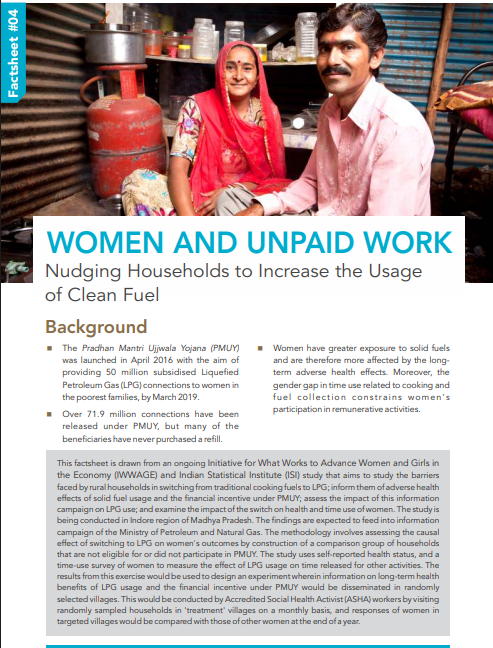
The methodology involves assessing the causal effect of switching to LPG on women’s outcomes by construction of a comparison group of households that are not eligible for or did not participate in PMUY. The study uses self-reported health status, and a time-use survey of women to measure the effect of LPG usage on time released for other activities. The results from this exercise would be used to design an experiment wherein information on long-term health benefits of LPG usage and the financial incentive under PMUY would be disseminated in randomly selected villages. This would be conducted by Accredited Social Health Activist (ASHA) workers by visiting randomly sampled households in treatment villages on a monthly basis, and responses of women in targeted villages would be compared with those of other women at the end of a year. The study is being conducted in Indore region of Madhya Pradesh.
The methodology involves assessing the causal effect of switching to LPG on women’s outcomes by construction of a comparison group of households that are not eligible for or did not participate in PMUY. The study uses self-reported health status, and a time-use survey of women to measure the effect of LPG usage on time released for other activities. The results from this exercise would be used to design an experiment wherein information on long-term health benefits of LPG usage and the financial incentive under PMUY would be disseminated in randomly selected villages. This would be conducted by Accredited Social Health Activist (ASHA) workers by visiting randomly sampled households in treatment villages on a monthly basis, and responses of women in targeted villages would be compared with those of other women at the end of a year. The study is being conducted in Indore region of Madhya Pradesh.
Learning note
Women in Agriculture
- November , 2019
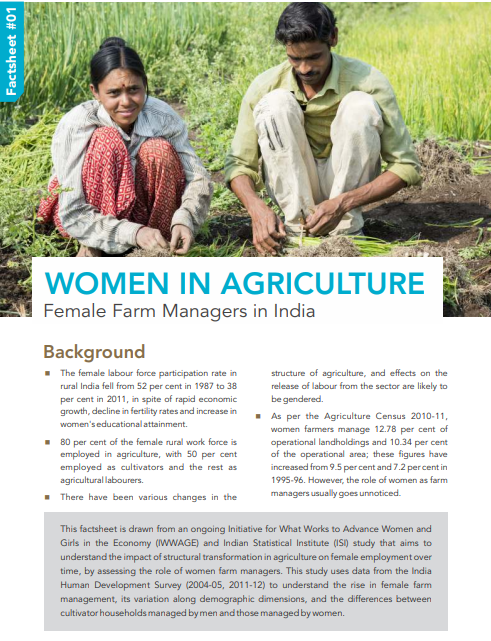
This factsheet presents insights from an IWWAGE and Indian Statistical Institute (ISI) study exploring the impact of structural transformation in agriculture on female employment, with a focus on women farm managers. Using data from the India Human Development Survey (2004-05, 2011-12), the study examines the rise in female farm management, its demographic variations, and key differences between households managed by men and those managed by women. The findings aim to shed light on the evolving role of women in agriculture and its implications for employment.
This factsheet presents insights from an IWWAGE and Indian Statistical Institute (ISI) study exploring the impact of structural transformation in agriculture on female employment, with a focus on women farm managers. Using data from the India Human Development Survey (2004-05, 2011-12), the study examines the rise in female farm management, its demographic variations, and key differences between households managed by men and those managed by women. The findings aim to shed light on the evolving role of women in agriculture and its implications for employment.
Report
Digitisation of Self-Help Groups in India
- August , 2019
- Sharon Buteau | Jithin Jose | Kriti Chouhan
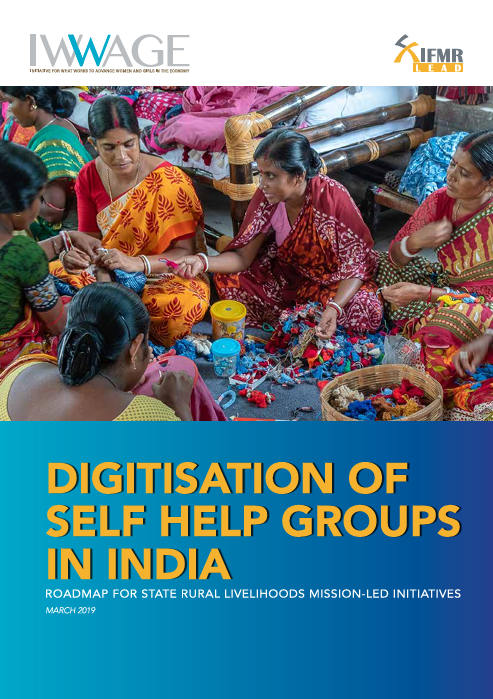
Self Help Groups (SHGs) have become essential for empowering women in India. Digitisation of SHG processes can streamline operations, addressing challenges like inefficient monitoring, data fragmentation, and capacity-building gaps. The Deendayal Antyodaya Yojana-National Rural Livelihoods Mission (DAY-NRLM) and its state chapters have made significant progress in this area. This report provides an assessment and roadmap for State Rural Livelihoods Missions (SRLMs) to digitise SHG processes effectively. It highlights current initiatives, identifies gaps, and suggests ways to address them. While Management Information Systems (MIS) have been digitised to some extent, many SRLMs face challenges such as resource shortages and limited IT capabilities, which hinder progress. Additionally, SHGs often lack clarity on the benefits of digitisation, leading to low community ownership. Most programmes rely on manual data entry, with few using digital tools at the ground level. SHG members and stakeholders beyond SRLMs and banks have limited access to the data. Improved data quality and use are essential for better financial outcomes for SHGs. Digital linkages for livelihoods and markets are underdeveloped, with innovations remaining small and context-dependent. Additionally, digital platforms for learning are underutilised due to limited smartphone and internet access in rural areas. The success of digitisation initiatives depends on partnerships between implementing agencies and Technology Service Providers (TSPs). Flexible models, like those seen in Andhra Pradesh and Jharkhand, offer promising examples for the future. Addressing these challenges will be crucial for the long-term success and sustainability of SHG digitisation efforts.
Self Help Groups (SHGs) have become essential for empowering women in India. Digitisation of SHG processes can streamline operations, addressing challenges like inefficient monitoring, data fragmentation, and capacity-building gaps. The Deendayal Antyodaya Yojana-National Rural Livelihoods Mission (DAY-NRLM) and its state chapters have made significant progress in this area. This report provides an assessment and roadmap for State Rural Livelihoods Missions (SRLMs) to digitise SHG processes effectively. It highlights current initiatives, identifies gaps, and suggests ways to address them. While Management Information Systems (MIS) have been digitised to some extent, many SRLMs face challenges such as resource shortages and limited IT capabilities, which hinder progress. Additionally, SHGs often lack clarity on the benefits of digitisation, leading to low community ownership. Most programmes rely on manual data entry, with few using digital tools at the ground level. SHG members and stakeholders beyond SRLMs and banks have limited access to the data. Improved data quality and use are essential for better financial outcomes for SHGs. Digital linkages for livelihoods and markets are underdeveloped, with innovations remaining small and context-dependent. Additionally, digital platforms for learning are underutilised due to limited smartphone and internet access in rural areas. The success of digitisation initiatives depends on partnerships between implementing agencies and Technology Service Providers (TSPs). Flexible models, like those seen in Andhra Pradesh and Jharkhand, offer promising examples for the future. Addressing these challenges will be crucial for the long-term success and sustainability of SHG digitisation efforts.