

This factsheet highlights Tamil Nadu’s strong female labor force participation, surpassing the national average, supported by key initiatives like Pudhumai Penn and the Thozhi hostel programme. It explores how these schemes have boosted women’s employment in both urban manufacturing and rural agriculture, drawing insights from the Periodic Labour Force Survey (PLFS).
Women's Economic
Empowerment
IWWAGE’s work on women’s economic empowerment focuses on understanding and addressing the structural barriers that shape women’s participation in India’s labour market. At the centre of this agenda is the persistently low Female Labour Force Participation Rate (FLFPR), which reflects deep-rooted challenges related to access to decent work, social norms, and labour market institutions.
IWWAGE’s work in this area focuses on:
Evidence generation for policy action
Analysing national and state-level data to understand women’s employment patterns, sectoral and occupational distribution, and barriers to labour market entry and continuity.
Improving measurement and visibility of women’s work
Improved definitions and measurement of work, with a strong emphasis on recognising unpaid, home-based, and care work that remains undercounted in conventional labour statistics.
Shaping the future of women’s work
Examining women’s participation in a rapidly digitising economy, including platform and hybrid work models, to assess emerging opportunities, risks, and forms of precarity.
Strengthening agency and protection
Exploring women’s access to digital skills, agency, bargaining power, and social protection within evolving labour market arrangements.
Together, this body of work highlights that meaningful women’s economic empowerment requires better data, recognition of all forms of work, and the proactive shaping of labour market institutions so that women’s work is visible, valued, and protected.
Factsheet
Trends in Female Labour and Workforce Participation – Tamil Nadu
- March , 2025
- Aneek Choudhary, Bidisha Mondal
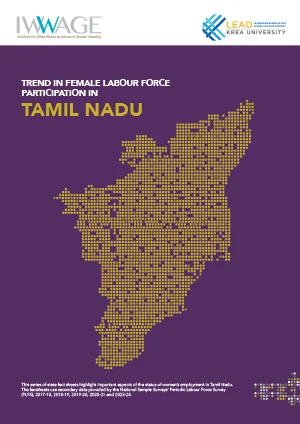
This factsheet highlights Tamil Nadu’s strong female labor force participation, surpassing the national average, supported by key initiatives like Pudhumai Penn and the Thozhi hostel programme. It explores how these schemes have boosted women’s employment in both urban manufacturing and rural agriculture, drawing insights from the Periodic Labour Force Survey (PLFS).
This factsheet highlights Tamil Nadu’s strong female labor force participation, surpassing the national average, supported by key initiatives like Pudhumai Penn and the Thozhi hostel programme. It explores how these schemes have boosted women’s employment in both urban manufacturing and rural agriculture, drawing insights from the Periodic Labour Force Survey (PLFS).