

Gujarat records a female labour force participation rate above the national average, supported by government policies promoting women’s economic empowerment. Schemes such as Mukhyamantri Mahila Utkars Yojana and Mahila Swavalamban Scheme strengthen financial inclusion, self-help groups, and access to credit for women, especially those below the poverty line. The state also promotes women’s entrepreneurship through targeted training and awareness programmes. Using PLFS 2023–24 data, this factsheet examines women’s employment in Gujarat, focusing on job types, sectoral distribution, and key indicators shaping female workforce participation.
Women's Economic
Empowerment
IWWAGE’s work on women’s economic empowerment focuses on understanding and addressing the structural barriers that shape women’s participation in India’s labour market. At the centre of this agenda is the persistently low Female Labour Force Participation Rate (FLFPR), which reflects deep-rooted challenges related to access to decent work, social norms, and labour market institutions.
IWWAGE’s work in this area focuses on:
Evidence generation for policy action
Analysing national and state-level data to understand women’s employment patterns, sectoral and occupational distribution, and barriers to labour market entry and continuity.
Improving measurement and visibility of women’s work
Improved definitions and measurement of work, with a strong emphasis on recognising unpaid, home-based, and care work that remains undercounted in conventional labour statistics.
Shaping the future of women’s work
Examining women’s participation in a rapidly digitising economy, including platform and hybrid work models, to assess emerging opportunities, risks, and forms of precarity.
Strengthening agency and protection
Exploring women’s access to digital skills, agency, bargaining power, and social protection within evolving labour market arrangements.
Together, this body of work highlights that meaningful women’s economic empowerment requires better data, recognition of all forms of work, and the proactive shaping of labour market institutions so that women’s work is visible, valued, and protected.
Factsheet
Trends in Female Labour Force Participation in Gujrat
- April , 2025
- Aneek Choudhary and Bidisha Mondal
Gujarat records a female labour force participation rate above the national average, supported by government policies promoting women’s economic empowerment. Schemes such as Mukhyamantri Mahila Utkars Yojana and Mahila Swavalamban Scheme strengthen financial inclusion, self-help groups, and access to credit for women, especially those below the poverty line. The state also promotes women’s entrepreneurship through targeted training and awareness programmes. Using PLFS 2023–24 data, this factsheet examines women’s employment in Gujarat, focusing on job types, sectoral distribution, and key indicators shaping female workforce participation.
Gujarat records a female labour force participation rate above the national average, supported by government policies promoting women’s economic empowerment. Schemes such as Mukhyamantri Mahila Utkars Yojana and Mahila Swavalamban Scheme strengthen financial inclusion, self-help groups, and access to credit for women, especially those below the poverty line. The state also promotes women’s entrepreneurship through targeted training and awareness programmes. Using PLFS 2023–24 data, this factsheet examines women’s employment in Gujarat, focusing on job types, sectoral distribution, and key indicators shaping female workforce participation.
Factsheet
Trends in Female Labour Force and Workforce Participation- Haryana
- April , 2025
- Vidhi, Aneek Choudhary and Bidisha Mondal
Haryana has transitioned from an agrarian to a more industrial economy, characterized by strong agricultural output and growing sectors such as automotive and IT. Despite economic growth, unemployment remains high, particularly among youth and women, due to limited formal job opportunities and structural challenges. This factsheet analyses female labour force participation in Haryana from 2017–18 to 2023–24, highlighting sectoral trends, occupational segregation, and barriers to workforce entry.
Haryana has transitioned from an agrarian to a more industrial economy, characterized by strong agricultural output and growing sectors such as automotive and IT. Despite economic growth, unemployment remains high, particularly among youth and women, due to limited formal job opportunities and structural challenges. This factsheet analyses female labour force participation in Haryana from 2017–18 to 2023–24, highlighting sectoral trends, occupational segregation, and barriers to workforce entry.
Haryana has transitioned from an agrarian to a more industrial economy, characterized by strong agricultural output and growing sectors such as automotive and IT. Despite economic growth, unemployment remains high, particularly among youth and women, due to limited formal job opportunities and structural challenges. This factsheet analyses female labour force participation in Haryana from 2017–18 to 2023–24, highlighting sectoral trends, occupational segregation, and barriers to workforce entry.
Factsheet
Trends in Female Labour Force Participation in Uttar Pradesh
- April , 2025
- Aneek Choudhary and Bidisha Mondal
Uttar Pradesh, India’s most populous state, has a large working-age female population but a female labor force participation rate that is well below the national average. Regional disparities, weak infrastructure in eastern UP, restrictive socio-cultural norms, and limited economic opportunities contribute to low participation. Female workforce participation has improved since 2017–18, supported by schemes such as the Mudra Yojana and Deendayal Antyodaya Yojana, which have expanded women’s access to credit, strengthened self-help groups, and promoted women’s economic empowerment across the state.
Uttar Pradesh, India’s most populous state, has a large working-age female population but a female labor force participation rate that is well below the national average. Regional disparities, weak infrastructure in eastern UP, restrictive socio-cultural norms, and limited economic opportunities contribute to low participation. Female workforce participation has improved since 2017–18, supported by schemes such as the Mudra Yojana and Deendayal Antyodaya Yojana, which have expanded women’s access to credit, strengthened self-help groups, and promoted women’s economic empowerment across the state.
Factsheet
Trends in Female Labour and Workforce Participation-Bihar
- April , 2025
- Aneek Choudhary and Bidisha Mondal
Bihar, despite being one of India’s fastest-growing states, has the lowest female labour force participation rate, alongside a widening gender gap. Policy focus on girls’ education, skills, entrepreneurship, and social support through schemes such as the Balika Cycle Yojana, Akshar Anchal Yojana, and Kanya Suraksha Yojana have contributed to recent improvements in female participation. Using PLFS data, this factsheet examines trends and key characteristics of women’s employment in Bihar.
Bihar, despite being one of India’s fastest-growing states, has the lowest female labour force participation rate, alongside a widening gender gap. Policy focus on girls’ education, skills, entrepreneurship, and social support through schemes such as the Balika Cycle Yojana, Akshar Anchal Yojana, and Kanya Suraksha Yojana have contributed to recent improvements in female participation. Using PLFS data, this factsheet examines trends and key characteristics of women’s employment in Bihar.
Report
The Changing World of Women’s Work
- April , 2025
- Bidisha Mondal, Prakriti Sharma, Aneek Chowdhury, Anjali S
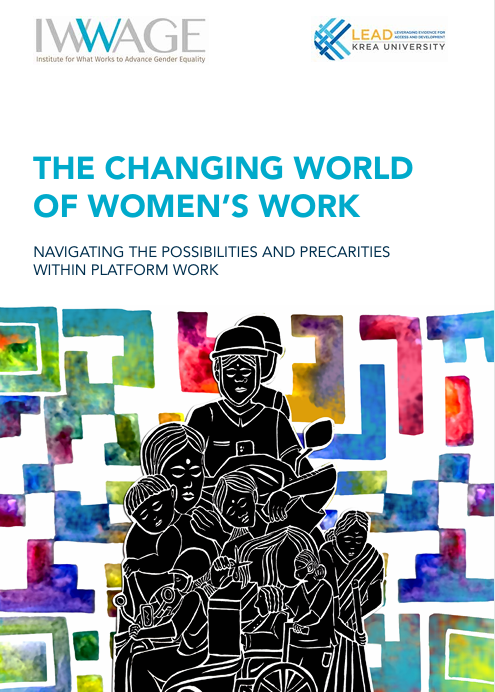
This study examines women’s participation in India’s platform economy using a mixed-methods approach, combining a survey of 598 platform workers (440 women) across care, domestic, beauty, ride-sharing, and delivery services with qualitative interviews. While platform work offers new entry points and flexibility, it often mirrors and deepens the precarity of informal work, limiting its potential for women’s empowerment. Persistent challenges include income instability, high entry and platform costs, limited social protection, unsafe conditions, and reinforced gender inequalities. Meaningful progress requires coordinated action by policymakers, platforms, and worker collectives to ensure fair earnings, social security, gender-sensitive systems, and effective grievance redressal
This study examines women’s participation in India’s platform economy using a mixed-methods approach, combining a survey of 598 platform workers (440 women) across care, domestic, beauty, ride-sharing, and delivery services with qualitative interviews. While platform work offers new entry points and flexibility, it often mirrors and deepens the precarity of informal work, limiting its potential for women’s empowerment. Persistent challenges include income instability, high entry and platform costs, limited social protection, unsafe conditions, and reinforced gender inequalities. Meaningful progress requires coordinated action by policymakers, platforms, and worker collectives to ensure fair earnings, social security, gender-sensitive systems, and effective grievance redressal
Report
Women and Work: How India fared in 2024
- April , 2025
- Aishwarya Bhuta, Harshita Kumari, Sohinee Thakurta, and Teesta Shukla.
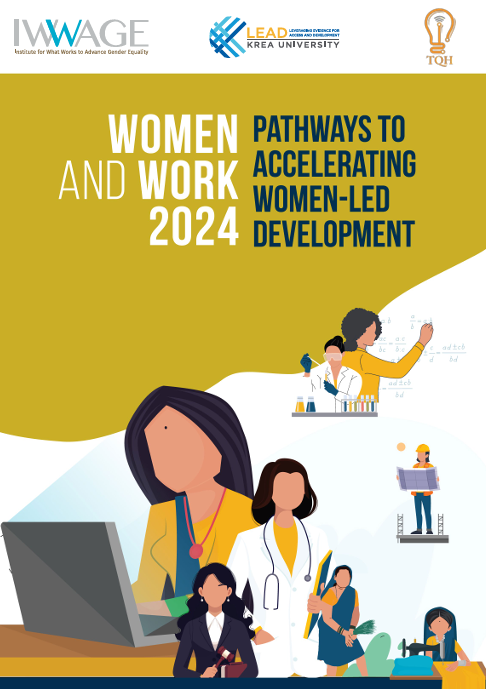
The year 2024 marked a key moment for women and work in India, shaped by economic shifts, policy action, and technological change. Since 2021–22, new challenges and opportunities have influenced women’s workforce participation, alongside renewed efforts to advance women’s economic empowerment. Building on the vision of women-led development highlighted during India’s 2023 G20 presidency, momentum continued across multiple initiatives. This report examines key trends, policy developments, and emerging challenges shaping women’s work in 2024. Drawing on secondary data and research from IWWAGE and LEAD, it maps the evolving landscape of women’s work in India and identifies pathways to greater inclusion and economic agency.
The year 2024 marked a key moment for women and work in India, shaped by economic shifts, policy action, and technological change. Since 2021–22, new challenges and opportunities have influenced women’s workforce participation, alongside renewed efforts to advance women’s economic empowerment. Building on the vision of women-led development highlighted during India’s 2023 G20 presidency, momentum continued across multiple initiatives. This report examines key trends, policy developments, and emerging challenges shaping women’s work in 2024. Drawing on secondary data and research from IWWAGE and LEAD, it maps the evolving landscape of women’s work in India and identifies pathways to greater inclusion and economic agency.