

Women's Economic
Empowerment
IWWAGE’s work on women’s economic empowerment focuses on understanding and addressing the structural barriers that shape women’s participation in India’s labour market. At the centre of this agenda is the persistently low Female Labour Force Participation Rate (FLFPR), which reflects deep-rooted challenges related to access to decent work, social norms, and labour market institutions.
IWWAGE’s work in this area focuses on:
Evidence generation for policy action
Analysing national and state-level data to understand women’s employment patterns, sectoral and occupational distribution, and barriers to labour market entry and continuity.
Improving measurement and visibility of women’s work
Improved definitions and measurement of work, with a strong emphasis on recognising unpaid, home-based, and care work that remains undercounted in conventional labour statistics.
Shaping the future of women’s work
Examining women’s participation in a rapidly digitising economy, including platform and hybrid work models, to assess emerging opportunities, risks, and forms of precarity.
Strengthening agency and protection
Exploring women’s access to digital skills, agency, bargaining power, and social protection within evolving labour market arrangements.
Together, this body of work highlights that meaningful women’s economic empowerment requires better data, recognition of all forms of work, and the proactive shaping of labour market institutions so that women’s work is visible, valued, and protected.
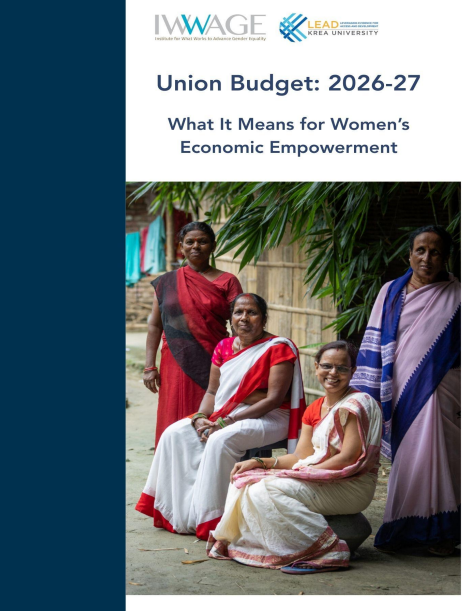
Union Budget: 2026-27 What It Means for Women’s Economic Empowerment
- February , 2026
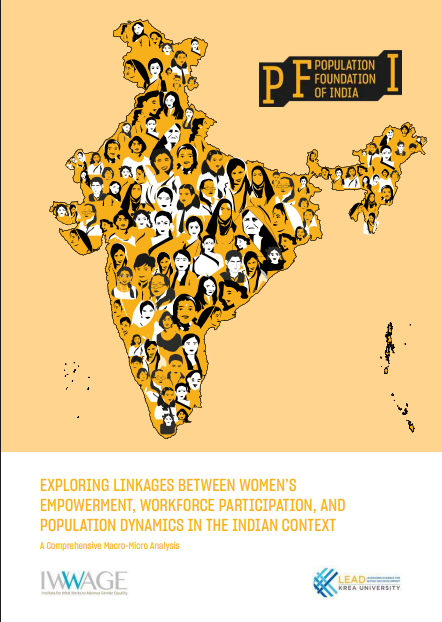
Exploring linkages between womens empowerment workforce participation and population dynamics in the Indian context: A comprehensive macro micro analysis
- November , 2025
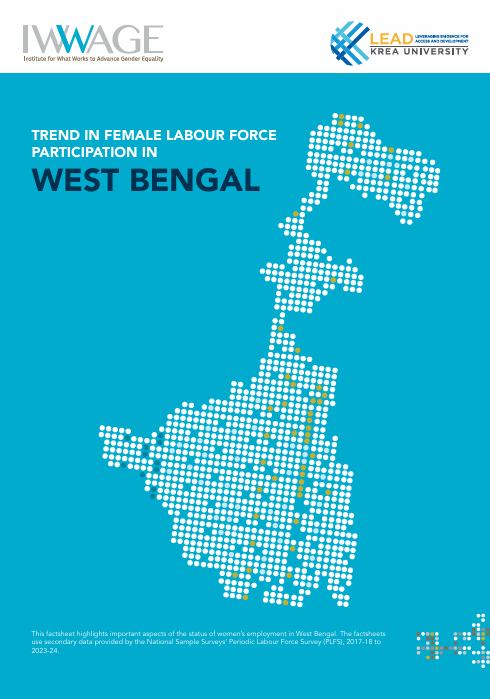
Trends in Female Labour Force Participation in West Bengal
- October , 2025
- Vidhi and Bidhisha Mondal
West Bengal has seen strong economic growth driven by manufacturing, MSMEs and investment, with GSDP projected to grow 12 per cent in 2025–26. However, per capita income remains below the national average. The state has lost around 3 million informal jobs in recent years, disproportionately affecting women, while high outmigration, especially of skilled workers, continues to reshape the labour market. Women remain concentrated in low-productivity informal sectors such as agriculture and domestic work, resulting in low female labour force participation and underscoring the need for targeted employment policies.
Trends in Female Labour and Workforce Participation- Meghalaya
- April , 2025
- Aneek Chowdhury, Bidisha Mondal
Trend In Female Labour Force and Workforce Participation- Telangana
- April , 2025
- Vidhi and Bidisha Mondal
Telangana has emerged as a major industrial and services-led economy, with GSDP growing nearly 197% between 2014–15 and 2023–24. Services contribute about two-thirds of GSVA, while industry has achieved near gender parity in employment due to targeted policy interventions. Agriculture remains a key employer, engaging 45.8% of the population but contributing a smaller share to GSDP. Women are largely concentrated in agriculture, while men dominate services. This factsheet examines trends in female labour force participation in Telangana from 2017–18 to 2023–24, focusing on sectoral distribution, occupational segregation, and workforce barriers.
Trends in Female Labour Force Participation in Assam
- April , 2025
- Aneek Choudhary, Vidhi and Bidisha Mondal
Assam has seen a notable rise in female labour force participation since 2021–22, exceeding the national average. However, data for 2022–23 shows an unusually wide gender gap and the lowest recorded female participation, largely due to an NSSO enumeration error that led to underreporting. In recent years, the state has introduced several pro-women initiatives focused on self-employment, skill development, and access to credit, which are expected to support higher female participation. Updated PLFS data will provide a clearer picture of emerging trends in women’s employment in Assam.