

Climate Change

IWWAGE’s work on climate change recognises that climate impacts are not gender-neutral. Climate stressors disproportionately affect women, girls, and socially marginalised communities, intensifying existing inequalities related to livelihoods, mobility, care responsibilities, and access to resources. IWWAGE examines these challenges through a gender equality, disability, and social inclusion (GEDSI) lens to ensure that climate responses are equitable, inclusive, and grounded in lived realities.

IWWAGE’s work on climate change focuses on:

Climate-induced migration and livelihoods

Analysing how climate shocks and slow-onset changes shape migration patterns, work opportunities, and vulnerabilities, particularly for women and marginalised groups.

Care burdens in a changing climate

Examining the invisible and expanding burden of unpaid care and domestic work as climate stress increases pressures on households and communities.

Women and access to clean

Assessing women’s access to clean, affordable, and reliable energy and its implications for health, livelihoods, time use, and resilience.

Gender-responsive climate policy and programmes

Reviewing the design and implementation of climate policies, adaptation strategies, and interventions to identify gaps and promote inclusive, intersectional approaches.

Strengthening agency and resilience

Advocating for climate action that meaningfully includes women and marginalised communities in decision-making and strengthens their capacity to adapt and lead.

Through this work, IWWAGE aims to inform socially just and gender-responsive climate action that addresses structural inequalities, enhances resilience, and ensures that no one is left behind.
Knowledge series

Migration Climate Change and Gender

Climate change is altering everyday life and livelihoods across India, and its impacts are not felt equally. Women, particularly those from marginalised and low-income communities, are often the first to absorb the effects of climate shocks, whether through disrupted livelihoods, migration, or the pressures of extreme weather. These experiences are shaped by long-standing social and economic inequalities, making it essential to look beyond sectoral solutions. One of the least visible but most affected areas is the care economy. As climate risks intensify, women’s unpaid and poorly paid care work expands, especially during displacement, crises, and recovery. Care work plays a critical role in helping families and communities cope with climate stress, yet it remains largely invisible within climate policy and planning. Looking at climate change through the lens of care helps reveal two connected dynamics: how climate risks reshape care responsibilities, and how the way care is organised influences resilience and adaptation. Recognising care, valuing women’s unpaid labour, and strengthening care systems are therefore not add-ons, but central to effective climate responses. This series of policy briefs, jointly developed by IWWAGE and PDAG, explores these connections in detail. It examines how care work is shaped by climate-related vulnerabilities, labour transitions, and forced mobility, with close attention to gendered outcomes. The series is part of a broader climate–gender conversation that includes work, migration, governance, and energy transitions, while centring experiences from India and the Global South. Through this initiative, we aim to deepen understanding, inform policy choices, and contribute meaningfully to ongoing discussions on climate change, care, and gender equality.
Knowledge series

Migration Climate Change and Gender

Climate change is altering everyday life and livelihoods across India, and its impacts are not felt equally. Women, particularly those from marginalised and low-income communities, are often the first to absorb the effects of climate shocks, whether through disrupted livelihoods, migration, or the pressures of extreme weather. These experiences are shaped by long-standing social and economic inequalities, making it essential to look beyond sectoral solutions. One of the least visible but most affected areas is the care economy. As climate risks intensify, women’s unpaid and poorly paid care work expands, especially during displacement, crises, and recovery. Care work plays a critical role in helping families and communities cope with climate stress, yet it remains largely invisible within climate policy and planning. Looking at climate change through the lens of care helps reveal two connected dynamics: how climate risks reshape care responsibilities, and how the way care is organised influences resilience and adaptation. Recognising care, valuing women’s unpaid labour, and strengthening care systems are therefore not add-ons, but central to effective climate responses. This series of policy briefs, jointly developed by IWWAGE and PDAG, explores these connections in detail. It examines how care work is shaped by climate-related vulnerabilities, labour transitions, and forced mobility, with close attention to gendered outcomes. The series is part of a broader climate–gender conversation that includes work, migration, governance, and energy transitions, while centring experiences from India and the Global South. Through this initiative, we aim to deepen understanding, inform policy choices, and contribute meaningfully to ongoing discussions on climate change, care, and gender equality.
Learning note

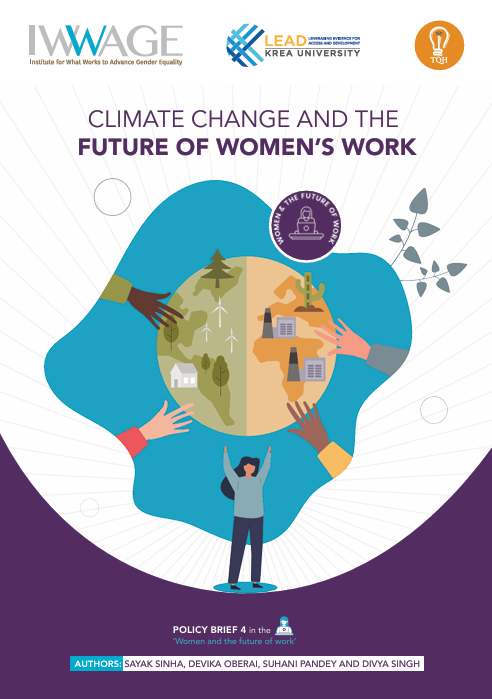
Climate Change and the Future of Women’s Work

Climate change is a pressing global challenge that exacerbates existing inequalities, disproportionately affecting women, girls, and marginalised communities. Due to persistent gender inequalities, women face unique challenges in adapting to climate-induced disasters, often lacking access to resources, financial services, and decision-making platforms needed to rebuild livelihoods. As a result, they are often slower to recover compared to men. International frameworks, such as the United Nations Framework Convention on Climate Change (UNFCCC) and the Lima Work Program on Gender, stress the importance of integrating gender perspectives into climate policies. However, there is a lack of sex-disaggregated data to fully understand the impact of climate change on women’s workforce participation. This highlights the urgent need for research on how climate change affects women’s livelihoods and the importance of advocating for policies that protect their participation in existing sectors while empowering them to enter emerging industries. By addressing these gendered impacts, we can create more equitable and sustainable solutions to climate change, ensuring that women play a key role in building climate-resilient communities.

Towards A Feminist Just Energy Transition in Asia

Energy transitions are not gender-neutral, and their impacts vary across social groups. In Asia, women—especially in rural and low-income communities—are disproportionately affected by energy poverty, environmental degradation, and climate change. Limited access to assets such as land and capital restricts women’s ability to adapt to transition processes. At the same time, women’s greater burden of unpaid care work reduces their access to paid employment, education, and training, weakening their capacity to navigate structural transitions. With Asia home to half of the world’s population and a large share living in poverty, these vulnerabilities are further intensified in the face of climate shocks (Oxfam 2022).
IWWAGE-ISI-BRIEFS

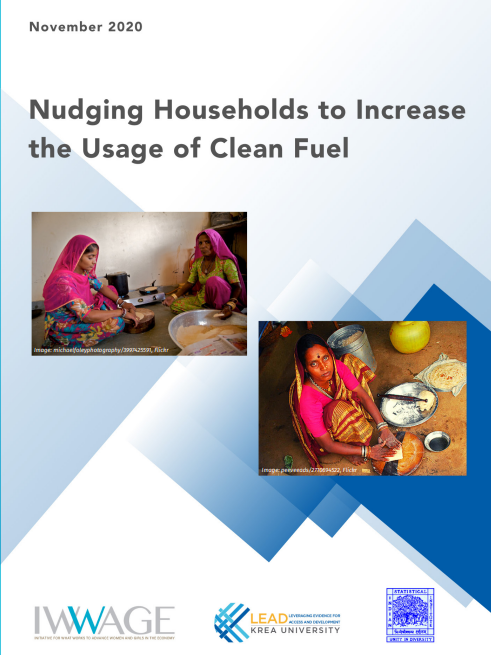
Nudging Households to increase the usage of Clean Fuel

Indoor air pollution, particularly from cooking with solid fuels, poses a severe public health risk, with women disproportionately bearing the burden. This project, based in rural Madhya Pradesh, investigates how targeted health communication and information on LPG subsidies can influence a shift towards cleaner cooking practices. Villages were randomly assigned to receive different interventions: health awareness alone, health awareness with information on the LPG subsidy programme, or no intervention (control). The combined campaign resulted in a 6% annual increase in LPG refill purchases, a 14% rise in monthly consumption, and a 320% boost in self-reported induction stove usage. While the ‘health only’ group did not show an increase in LPG use, there was improved adoption of safety measures such as smoke outlets or separate kitchens. These findings suggest that both awareness and financial accessibility are critical in enabling consistent clean fuel usage. Despite the significant expansion of LPG access under the Government of India’s Ujjwala Yojana scheme, sustained use remains limited due to low awareness about subsidy benefits and the health risks of solid fuels. This study underscores the importance of integrated communication and policy design in advancing cleaner, safer household energy use.
Scroll to Top