
Swayam
SWAYAM
About SWAYAM
Strengthening Women’s Institutions for Agency and Empowerment
Strengthening Women’s Institutions for Agency and Empowerment (SWAYAM), led by the Institute for What Works to Advance Gender Equality (IWWAGE), serves as the National Technical and Learning partner to the Deendayal Antyodaya Yojana-National Rural Livelihoods Mission (DAY-NRLM) to strengthen and deepen gender interventions.
BACKGROUND
DAY-NRLM believes that gender sensitisation and social action should be mainstreamed in its framework, systems, institutions and processes. To this end, it devised a Gender Operational Strategy in the financial year 2019-20 committing actions that recognise women’s heterogeneity and the unique socio-economic barriers they face.
Primary objective of program
Through this partnership, we aim to strengthen gender-responsive programming within the NRLM by focusing on capacity building, innovation, and evidence generation. Specifically, the partnership seeks to:
- Strengthen the capacity of staff at all levels in the NRLM through trainings to work on gender issues
- Redesign the existing gender training curriculum used by State Rural Livelihoods Mission
- Design and test innovative solutions for delivering the trainings
- Design, implement and evaluate the impact of Gender Resource Centres to promote gender equality and help women claim their entitlements
- Build performance indicators, generate rigorous evidence and develop knowledge management mechanisms to inform programme design
Core Components of SWAYAM
Capacity Builiding
Building Gender-Responsive Community Institutions
- Institutionalising and Standardising capacity-building process
Development of training modules to build the capacity of staff and cadres of the program.
- Participatory Gender Capacity Building
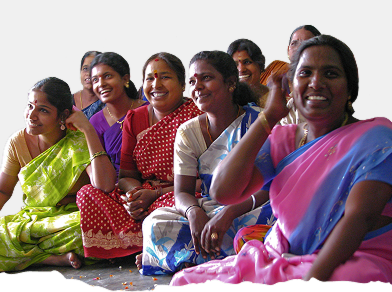
Community-led learning on gender norms, rights and entitlements, prevention of gender-based violence, and legal safeguards for SHGs, VOs, and CLFs.
- Piloting and Scaling Gender Resource Centres (GRCs)
GRCs function from block level to raise issues, engage with service providers, seek help from line departments and advocate for ending systemic and social barriers leading to violence & discrimination against women and marginalised sections of society.
- Institutionalising and Standardising capacity-building process
Development of training modules to build the capacity of staff and cadres of the program.
- Participatory Gender Capacity Building
Community-led learning on gender norms, rights and entitlements, prevention of gender-based violence, and legal safeguards for SHGs, VOs, and CLFs.
- Piloting and Scaling Gender Resource Centres (GRCs)
GRCs function from block level to raise issues, engage with service providers, seek help from line departments and advocate for ending systemic and social barriers leading to violence & discrimination against women and marginalised sections of society.
Research and Evidence Generation
Building collaborative evidence to strengthen systems
- Learning and Evidence
Testing and scaling what works through data-driven insights, continuous learning, and research to inform policies and programme design
- Ethnographic Research
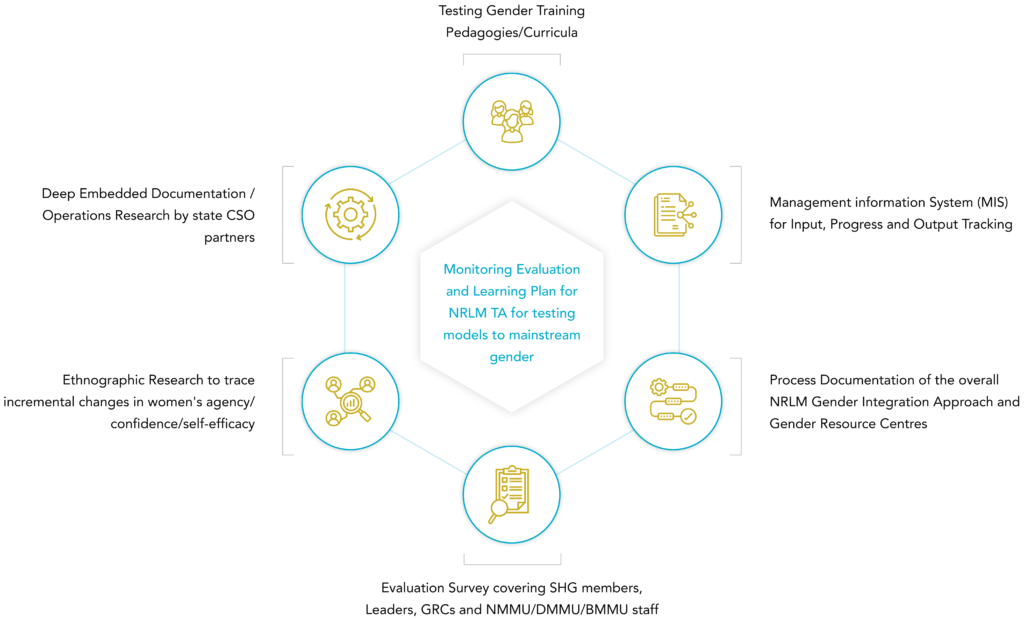
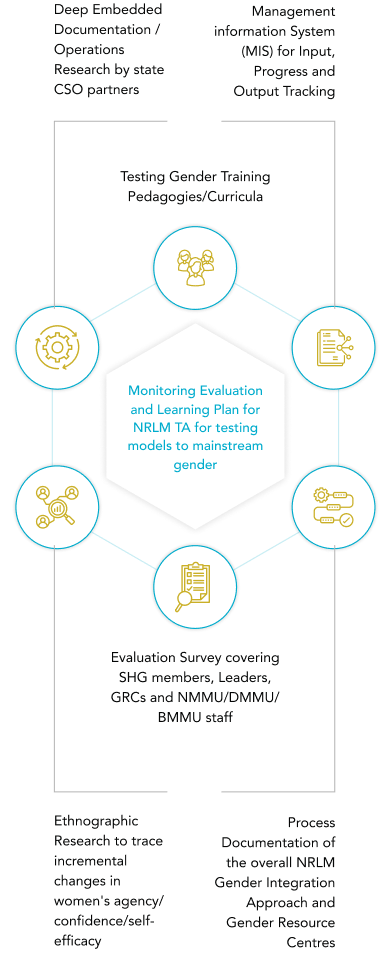
Ethnographic research tracks subtle, context-specific changes in women’s lives, such as confidence, decision-making, and economic choice, through interviews, FGDs, and allied contexts across states. These insights will help develop context-based, values-driven indicators to measure empowerment, justice, and accountability.
- Process Evaluation
The SWAYAM programme evaluation assesses changes in women’s empowerment, participation, and outcomes across pilot geographies, alongside a cross-state review of implementation processes. It also examines the institutional capacity, linkages, and long-term sustainability of Gender Resource Centres within existing community and government systems.
- Learning and Evidence
Testing and scaling what works through data-driven insights, continuous learning, and research to inform policies and programme design
- Ethnographic Research
Ethnographic research tracks subtle, context-specific changes in women’s lives, such as confidence, decision-making, and economic choice, through interviews, FGDs, and allied contexts across states. These insights will help develop context-based, values-driven indicators to measure empowerment, justice, and accountability.
- Process Evaluation
The SWAYAM programme evaluation assesses changes in women’s empowerment, participation, and outcomes across pilot geographies, alongside a cross-state review of implementation processes. It also examines the institutional capacity, linkages, and long-term sustainability of Gender Resource Centres within existing community and government systems.
Alliance & Advocacy
Strengthening systems through collective advocacy
- National Advocacy Platforms
Facilitating policy dialogue and knowledge exchange through platforms such as Gender Samvaad, bringing together policymakers, practitioners, and community leaders.
- Support to Nationwide Campaign titled Nayi Chetna
Supporting large-scale, community-led movements like Nayi Chetna to promote awareness, collective action, and a whole-of-government response to gender-based violence and women’s empowerment.
- National Advocacy Platforms
Facilitating policy dialogue and knowledge exchange through platforms such as Gender Samvaad, bringing together policymakers, practitioners, and community leaders.
- Support to Nationwide Campaign titled Nayi Chetna
Supporting large-scale, community-led movements like Nayi Chetna to promote awareness, collective action, and a whole-of-government response to gender-based violence and women’s empowerment.
Policy
Strengthening policy systems through data and evidence
- Policy Influence and Scale
Translating grassroots evidence into gender-transformative policies and scalable institutional models at the state and national levels.
- Management Information System (MIS)
A centralised, data-driven MIS is being established under DAY-NRLM to track, analyse, and report progress on gender-focused initiatives. It supports strategic planning, ensures accessible and accurate data for stakeholders, and enables evidence-based decision-making by Gender Resource Centres.
- Policy Influence and Scale
Translating grassroots evidence into gender-transformative policies and scalable institutional models at the state and national levels.
- Management Information System (MIS)
A centralised, data-driven MIS is being established under DAY-NRLM to track, analyse, and report progress on gender-focused initiatives. It supports strategic planning, ensures accessible and accurate data for stakeholders, and enables evidence-based decision-making by Gender Resource Centres.
Key Achievements and impact (as of january 2026)
Impact and Progress Highlights
- Developed 17 comprehensive gender training modules for DAY-NRLM staff and community cadres.
- Set up 5,000+ GRCs across 22 states, providing rural women access to support services related to gender-based violence, rights, entitlements, and grievance redressal.
- The three-year Gender Campaign generated robust evidence that informed concrete policy outputs and enabled structured convergence across multiple Ministries, strengthening institutional alignment on gender responsive interventions.
- Organised six editions of Gender Samvaad, bringing together policymakers, practitioners, and community leaders to share innovations, shape strategies, and influence policy.
Key Achievements and impact (as of january 2026)
Impact and Progress Highlights
- Developed 17 comprehensive gender training modules for DAY-NRLM staff and community cadres.
- Set up 5,000+ GRCs across 22 states, providing rural women access to support services related to gender-based violence, rights, entitlements, and grievance redressal.
- The three-year Gender Campaign generated robust evidence that informed concrete policy outputs and enabled structured convergence across multiple Ministries, strengthening institutional alignment on gender responsive interventions.
- Organised six editions of Gender Samvaad, bringing together policymakers, practitioners, and community leaders to share innovations, shape strategies, and influence policy.
Expanding the Reach of SWAYAM
SWAYAM’s future efforts will focus on scaling gender-responsive livelihoods and strengthening systems that advance women’s economic empowerment. This will be achieved through the development of Gender Operational Strategies (GOS) and by embedding gender perspectives into policies through rigorous evidence generation, learning, and advocacy.